
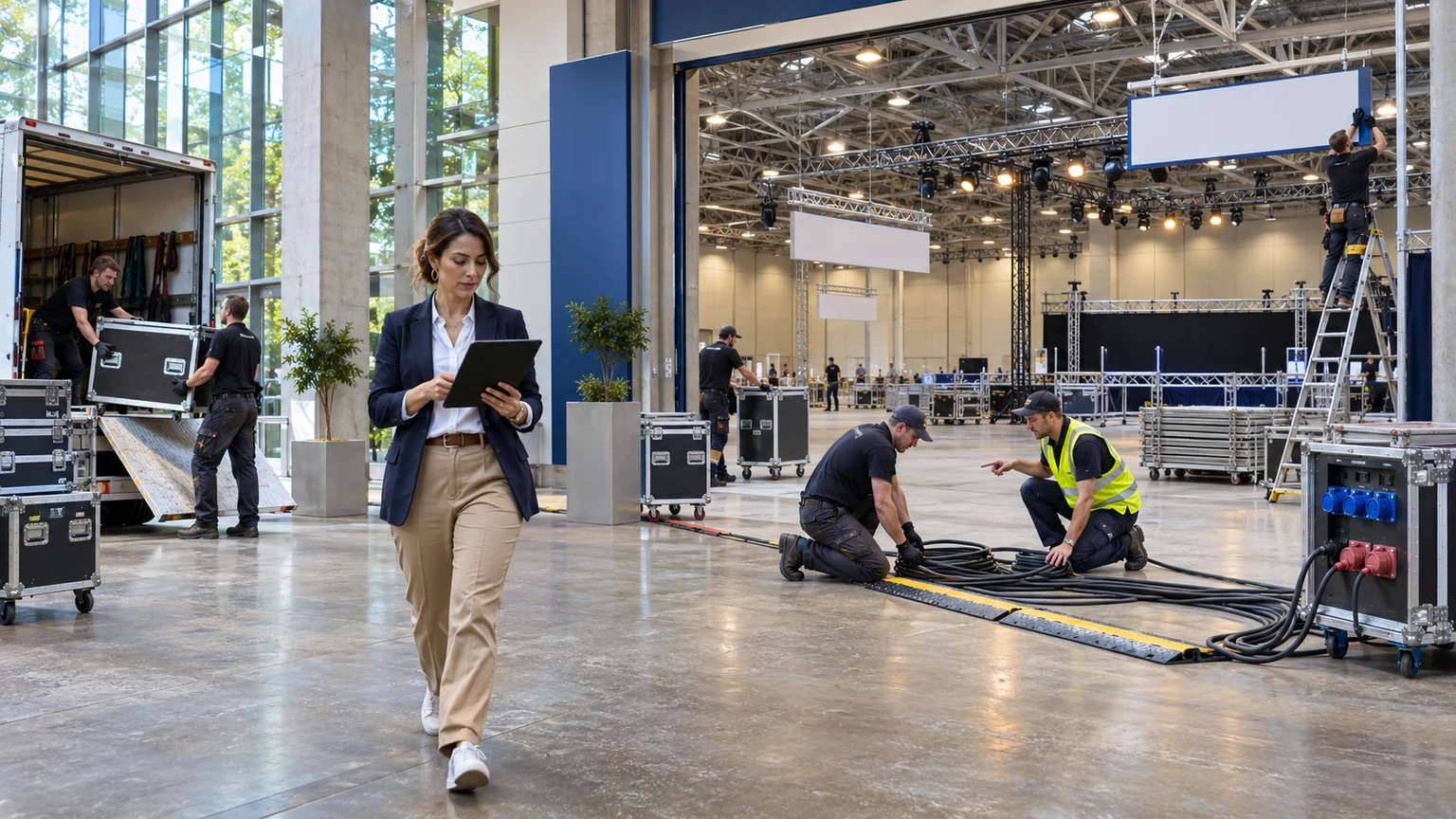
Large venue upgrades are easy to read as property news.
For event operators, they are more useful as an operations signal.
Recent reporting around Olympia’s large-scale transformation, and the broader rise of technology-focused events, points to a practical shift: venue readiness is becoming part of the event value proposition, not just a background condition.
That matters because tech-heavy events usually place more pressure on connectivity, power, loading, production coordination, exhibitor requirements, and on-site support.
What it does not prove on its own is that every upgraded venue will automatically win more events, that all technology events need the same infrastructure, or that investment alone fixes operational complexity.
Venue investment is not the event strategy. It is the operating foundation that can make stronger event strategies possible.
Why this matters for event operations
When a venue goes through major redevelopment, event teams should not only ask what looks new. They should ask what becomes easier, safer, faster, or more scalable to run.
That affects practical decisions across the event lifecycle:
- which event formats the venue can support credibly
- how organisers scope production and technical delivery
- what exhibitors expect from infrastructure and access
- how suppliers plan labour, install timing, and equipment flow
- whether attendee experience feels smooth or strained at peak moments
- how commercial teams position the event to sponsors and partners
For venues, the operational upside is not just prestige. It is the ability to host more demanding events with less friction.
For organisers, the upside is not simply a nicer building. It is a venue that better supports the event promise being sold.
What we can say, and what we cannot
From the source signal, it is reasonable to say that major venue transformation and increased attention on technology-focused events are connected in a meaningful way. As venues modernise, they may become better suited to events that depend on stronger infrastructure, more complex production, and higher expectations from exhibitors and attendees.
It is also reasonable to say that venue readiness is becoming more commercially important in sectors where event technology plays a central role.
What we cannot say from this source alone is:
- the exact operational specification of every upgraded space
- which event categories will benefit most in financial terms
- that infrastructure investment guarantees stronger attendance
- that every organiser will need the same technical setup
- that one venue project reflects the whole market equally
That distinction matters. Good event teams should treat venue investment as a planning signal, then test what it means for their own show format, audience, and supplier model.
A transformed venue can raise the ceiling for what an event can deliver, but the organiser still has to design the event well.
Why tech-heavy events raise the operational bar
Technology-focused events often look content-led from the outside, but operationally they are usually infrastructure-led.
Even when the programme is strong, the experience can break down if the venue cannot support the event's real demands.
Those demands often include:
- reliable connectivity for demos, apps, streaming, and exhibitor activity
- power capacity for staging, stands, charging, and specialist equipment
- efficient loading and build schedules for production-heavy installs
- clear back-of-house coordination between venue, organiser, and suppliers
- room layouts that support both content consumption and live interaction
- crowd flow that can handle high-interest launches, sessions, or activations
This is why venue readiness matters more as event formats become more digital, more interactive, and more production-intensive.
Start with operating requirements, not venue marketing
When a venue announces a major upgrade, organisers can be tempted to respond to the headline first.
A better approach is to translate the news into an operating checklist.
Ask simple questions:
- what event constraints might this upgrade reduce
- which production risks could become easier to manage
- what attendee pain points might improve
- what exhibitor expectations might rise as a result
- which parts of our current event design depend heavily on venue capability
This helps teams avoid two common mistakes.
The first is assuming a refurbished venue solves every operational issue.
The second is failing to adapt event design after the venue standard has clearly moved upward.
Where the operational opportunities may be strongest
1. More ambitious event formats
When venue capability improves, organisers may be able to run formats that were previously hard to deliver well.
That could include larger demonstration areas, more integrated content stages, stronger sponsor activations, or more complex hybrid production environments.
The key is discipline. New capability should support audience value, not just add cost.
2. Better exhibitor and sponsor delivery
Exhibitors at technology events often judge the venue indirectly through setup ease, infrastructure reliability, and visitor flow.
If venue upgrades improve access, utilities, navigation, or production support, exhibitor experience can improve materially.
That can influence renewal confidence just as much as headline attendance numbers.
3. Higher service expectations
Improved venues usually create improved expectations.
Attendees may expect smoother entry, better amenities, clearer wayfinding, more dependable connectivity, and a more polished overall experience.
Sponsors and exhibitors may also expect faster response times and fewer workarounds.
That means venue investment can raise the standard for the organiser too.
What organisers should review now
If your event depends on modern venue infrastructure, this is a good moment to review whether your planning assumptions are still current.
Focus on the parts of the operation where venue capability and event design meet:
- production scope and technical dependencies
- internet and power assumptions across stages and expo areas
- move-in and move-out scheduling
- speaker, sponsor, and exhibitor service workflows
- registration, entry, and circulation design
- space planning for demos, meetings, and networking
In some cases, a venue upgrade may support a better event without major redesign.
In other cases, it may justify a more substantial rethink of format, floor plan, sponsorship inventory, or programme flow.
What venue teams should communicate clearly
For venue operators, investment only becomes commercially useful when organisers can understand it in operational terms.
That means moving beyond broad claims about transformation and clearly explaining what has changed for event delivery.
The most helpful venue communication usually covers:
- what kinds of events the venue is better equipped to support
- which operational pain points have been reduced
- how technical and production teams will work with organisers
- what suppliers need to know about access and build conditions
- where capacity, flexibility, or service levels have improved
This is especially important when targeting technology-focused events, where buyers often need confidence in infrastructure long before they care about aesthetics.
Where teams should be careful
There are several ways to misread a major venue upgrade.
- do not assume new infrastructure removes the need for detailed technical planning
- do not oversell venue readiness without verifying event-specific requirements
- do not treat venue modernisation as a substitute for better event design
- do not ignore the possibility that costs and expectations rise together
- do not assume every audience segment values the same improvements equally
The practical question is not whether the venue is impressive. It is whether the upgraded environment makes the event easier to run and more valuable to attend.
What good looks like
A strong response to venue transformation is usually measured, not flashy.
The organiser reviews what new infrastructure enables, updates operational assumptions, aligns supplier planning early, and sharpens the attendee and exhibitor experience accordingly.
The venue supports that process with clear documentation, realistic promises, and strong delivery coordination.
When that happens, the result is not just a more modern setting. It is a more dependable event operation.
What this means for event teams
Large-scale venue upgrades should matter to event teams because they change what is practical to deliver.
In a market where technology-focused events continue to demand more from spaces, venue readiness becomes part of competitive positioning.
For organisers, the next step is simple: audit your event against the venue capabilities it now depends on.
For venue managers and suppliers, the priority is equally simple: translate investment into operational clarity.
That is where transformation stops being a headline and starts becoming useful.