
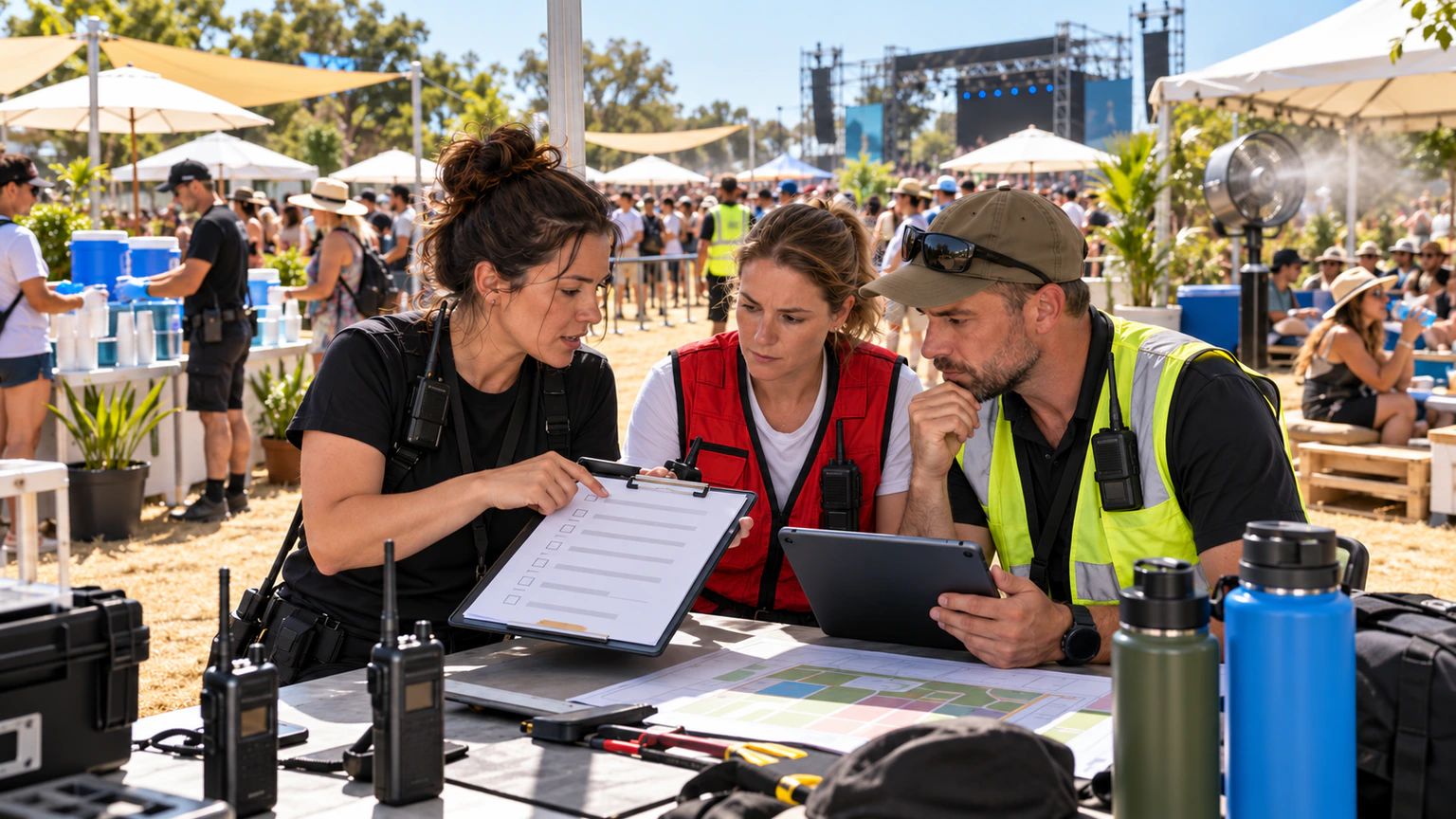
WHO guidance on preventing heat-related illness at mass gatherings is a useful planning signal for event organizers.
On its own, that public signal does not replace local regulation, medical direction, venue rules, or weather-specific risk assessment. But it does point to a clear operational priority: heat risk should be built into event planning before doors open, not managed only as an on-site reaction.
For festivals, outdoor conferences, sports-adjacent events, public gatherings, and queue-heavy venues, that matters because heat stress can affect attendees, staff, contractors, exhibitors, and suppliers at the same time.
Heat planning works best when it is treated as an operations system, not a welfare add-on.
Why this matters
Heat-related illness is not only a medical issue. It is also an event delivery issue.
When temperatures rise, several operational weak points show up quickly:
- entry queues become higher risk
- shade and water demand exceeds assumptions
- frontline staff fatigue earlier
- attendee movement slows
- medical teams receive preventable cases
- program timing becomes harder to hold
The goal is not to eliminate all weather-related pressure. It is to reduce avoidable exposure, spot risk early, and make response steps simple enough to use under pressure.
What the public signal actually tells us
From the source material available here, the confirmed signal is narrow but meaningful: WHO has released guidance aimed at preventing heat-related illness at mass gatherings.
That is enough to support a practical discussion about event readiness.
What it does not confirm on its own is the exact operating model every organizer should use, the legal standard in each market, or a single universal trigger for changing show conditions.
That distinction matters.
Public health guidance is a planning foundation. It still needs to be translated into site-specific decisions.
Start with a heat risk review, not a generic safety note
Many event plans mention weather in broad terms. That is not the same as a usable heat plan.
Before the event, review the conditions most likely to increase risk:
- time of day for peak attendance
- expected temperature and humidity
- direct sun exposure across queues, seating, and walkways
- surface heat from concrete, turf, metal, or temporary flooring
- distance between water points and high-density areas
- crowd profile, including older attendees, children, and people with pre-existing conditions
- uniform, PPE, or load-bearing requirements for staff
- alcohol service, physical activity, and waiting times
This review should end with named actions, not only observations.
A practical event heat checklist
1. Set decision ownership early
Someone needs authority to make heat-related operating calls.
Define in advance:
- who monitors conditions
- who approves mitigations
- who can pause queue build-up or program elements
- who communicates changes to vendors, staff, and attendees
- who coordinates with medical, security, and venue teams
If ownership is unclear, response becomes slower exactly when conditions are changing fastest.
2. Map the highest-risk locations on site
Do not assess the venue as one average environment. Heat risk is uneven.
Priority zones usually include:
- entry and security lines
- transport drop-off points
- temporary outdoor waiting areas
- standing-room viewing zones
- staff check-in and back-of-house compounds
- smoking areas and food lines
- exposed routes between halls or stages
Mark where people are likely to stand, not only where they are supposed to move.
3. Review water access operationally
Water availability is not just a procurement question. It is a placement and throughput question.
Check:
- how many refill or distribution points exist
- whether they are visible from high-density areas
- whether queues for water create new heat exposure
- whether staff have separate access from attendees
- how replenishment will be monitored during peaks
If water is technically available but slow to reach, the plan is weaker than it looks on paper.
4. Build shade and cooling into crowd flow
Temporary shade, cooling areas, and indoor relief spaces should support circulation, not fight it.
Practical checks include:
- shade at queue start, middle, and final approach
- rest areas near longer dwell zones
- clear signage to cooler indoor or lower-exposure spaces
- accessible routes to relief areas
- capacity assumptions for peak demand
For some events, the biggest improvement is simply moving a queue 20 meters to reduce direct sun.
5. Adjust staffing plans for heat exposure
Frontline teams often absorb more heat risk than attendees because they cannot leave their positions easily.
Review:
- shift lengths in exposed positions
- break frequency and break location
- supervisor checks for signs of heat stress
- access to water for security, stewards, cleaners, and crew
- job rotation for static roles
- uniform requirements that may increase heat burden
Contractors should be included in the same review, not handled as a separate afterthought.
6. Brief teams on what to spot and what to do
A heat plan becomes practical when non-medical staff know the basics.
Keep briefings simple:
- what symptoms should be escalated
- how to call medical support fast
- where the nearest relief or cooling point is
- when to move a guest out of a queue
- how to report repeat issues in one area
Long clinical explanations are less useful than clear action steps.
7. Prepare attendee communications before the event
Attendees make better decisions when guidance arrives early and sounds practical.
Useful pre-event messages may cover:
- expected conditions
- what to bring, if permitted
- where to find water and shade
- how to dress for the site conditions
- when gates open to reduce queue pressure
- when to seek help
These messages should also be repeated on event day across the app, SMS, email, signage, PA, and staff scripts where available.
8. Rework queues, not just the medical plan
Many heat-related problems begin in lines.
Ask operational questions such as:
- can gates open earlier if arrivals build in direct sun
- can screening lanes be flexed faster
- can credential problems be moved out of the main queue
- can bag check or wristbanding be redistributed
- can queue rails be repositioned into lower-exposure areas
Medical readiness matters, but prevention often starts with queue design.
9. Define escalation thresholds in plain language
Teams should not have to improvise what counts as a trigger.
Your operating plan should state what happens if:
- medical presentations increase beyond expectation
- water points begin failing or running low
- shade areas reach capacity
- queue times exceed the safe assumption for current conditions
- staff report repeated attendee distress in the same zone
Possible responses may include more announcements, opening extra access points, moving activities, delaying non-critical program moments, or increasing relief staffing.
How to run event-day heat monitoring
Heat plans often fail because conditions are reviewed too slowly.
A practical rhythm is to combine weather checks with field observations from operations, security, guest services, and medical teams.
Look for early warning signs:
- water queues getting longer
- guests sitting or lying down in circulation spaces
- more complaints from a single queue or plaza
- staff asking for unscheduled relief
- attendees clustering in limited shaded areas
These are operating signals, not just comfort complaints.
What organizers should not assume
There are several common mistakes in hot-weather planning:
- assuming a venue with some indoor space is automatically low risk
- assuming medical teams can compensate for weak prevention
- assuming attendees will self-manage without clear prompts
- assuming staff exposure is lower because they know the site
- assuming the hottest part of the day is the only period that matters
Heat exposure often builds through repeated waiting, walking, carrying, and standing.
A compact checklist for operations leads
- Assign a heat-risk decision owner.
- Map exposed zones and long dwell points.
- Confirm water placement, signage, and replenishment.
- Review shade, cooling, and relief capacity.
- Adjust queue plans for likely peak heat windows.
- Build staff rotation and break coverage for exposed roles.
- Brief frontline teams on symptoms and escalation.
- Prepare attendee messages before arrival.
- Set plain-language escalation triggers.
- Monitor live conditions and field reports throughout the day.
Stay evidence-aware
The value of the WHO signal is not that it gives every organizer the same script. It is that it reinforces a real operational responsibility: mass gatherings need deliberate planning for heat-related illness prevention.
Teams should still align any checklist with local public health guidance, venue policies, emergency partners, and the specific profile of their audience and site.
What this means for event teams
If heat risk is relevant to your event, the most useful next step is simple: turn general guidance into named operational actions.
That means deciding who watches conditions, where risk will build first, how people get water and relief, how staff rotate, what attendees are told, and when the event changes course.
In practice, the best heat plan is usually not the most complicated one. It is the one the team can actually run.