
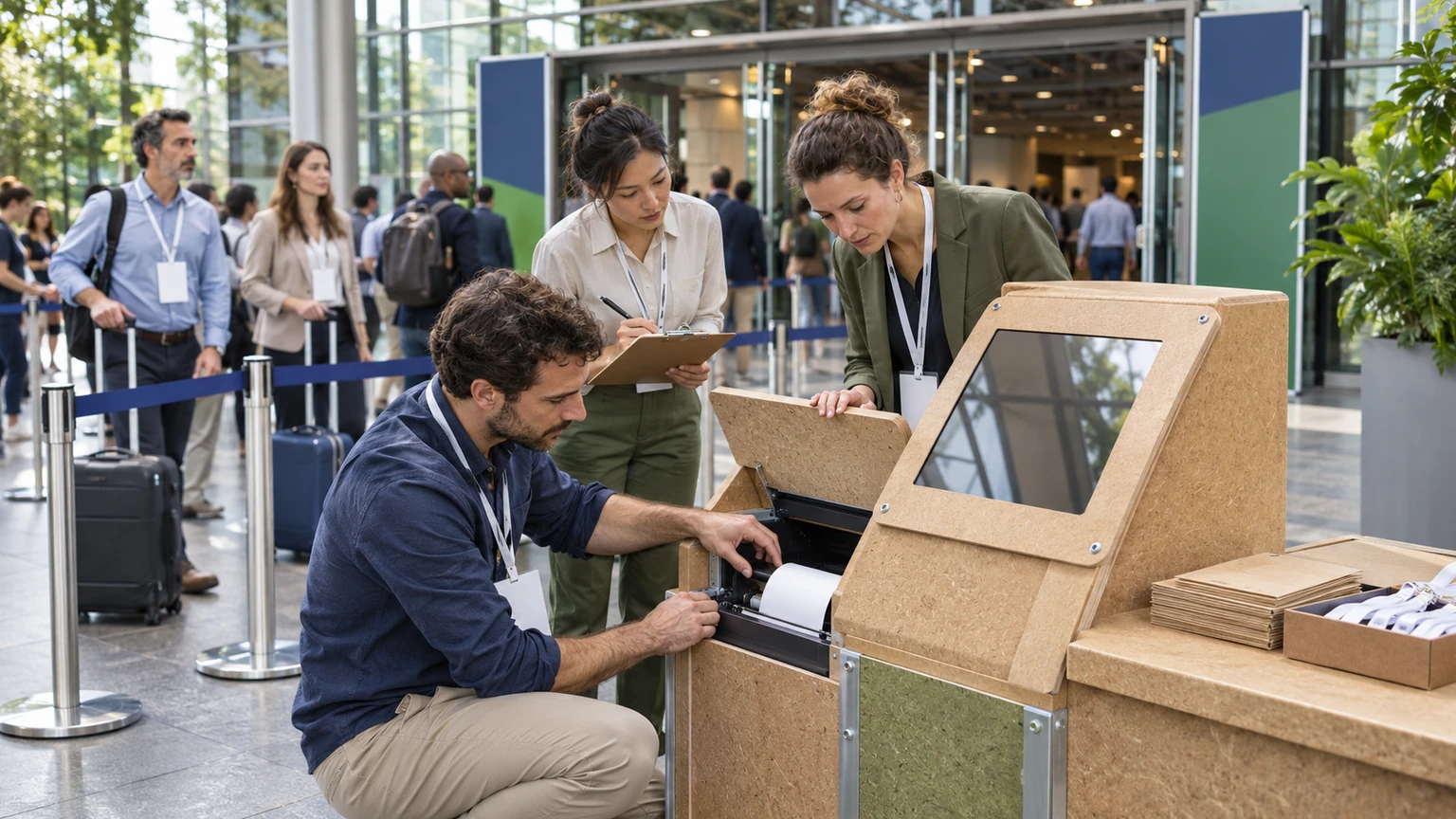
Sustainability goals often sound clear in strategy meetings and much harder in the registration hall.
That is why recent reporting around Sprintr and One World Group expanding recyclable event registration kiosks is useful for event teams. It points to a practical shift: on-site attendee management is starting to be evaluated not only for speed and reliability, but also for material impact.
For organisers of large conferences, the question is not whether a kiosk can look greener. It is whether a recyclable kiosk deployment can still handle peak arrivals, badge output, staffing pressure, and exception management without creating new operational problems.
What this does not prove on its own is that every recyclable kiosk model performs equally well, that one supplier approach will fit every venue, or that sustainability claims automatically translate into lower total event impact.
A sustainable check-in setup only works if it remains a dependable operational setup.
Why this matters for event operations
Registration kiosks sit at a sensitive point in the attendee journey. If they fail, queues form quickly, staff get pulled into avoidable troubleshooting, and first impressions worsen.
At the same time, large events are under more pressure to reduce waste, improve reporting, and make procurement choices that support broader environmental targets.
Recyclable kiosks matter because they bring those two priorities into the same decision.
If deployed well, they may help organisers:
- reduce reliance on harder-to-reuse build materials
- align registration infrastructure with event sustainability targets
- improve supplier conversations around lifecycle and recovery
- show sponsors, venues, and attendees that operational sustainability is being addressed in visible areas
- standardise a lower-waste approach across repeat events
If deployed badly, they can create a different set of problems:
- unstable hardware placement
- poor cable management
- slower check-in throughput
- confusion around replacement parts or repairs
- more manual intervention at peak periods
What we can say, and what we cannot
From the source signal, it is reasonable to say that recyclable event registration kiosks are gaining attention and that suppliers see enough demand to expand in this area.
It is also reasonable to say that organisers should expect more questions about sustainability within front-of-house event technology procurement.
What we cannot say from this source alone is:
- the exact materials, recovery process, or durability profile of every kiosk model
- whether recyclable kiosks outperform standard kiosks operationally
- the measured carbon or waste reduction for a given event
- how each vendor handles transport, refurbishment, or end-of-life processing
- that a recyclable kiosk deployment is automatically the best sustainability choice in every event context
That distinction matters. Event teams should treat this as a relevant market signal, then test suppliers carefully against real operating needs.
The right procurement question is not only, “Is this recyclable?” It is, “Can this run our registration operation reliably, at scale, with a credible end-of-life plan?”
Start with the operating requirement, not the sustainability label
Many teams make the same mistake with greener infrastructure choices: they begin with the claim, not the workflow.
A better starting point is to define what the kiosk deployment must actually do.
For a large conference, that usually includes:
- supporting the expected arrival volume by hour
- handling badge printing or badge lookup accurately
- fitting the venue footprint and queue plan
- working with available power and connectivity
- remaining stable and usable across the full event day
- allowing fast intervention when an attendee needs help
- being practical to install, dismantle, transport, and recover
Only after those requirements are clear should sustainability criteria be applied in a structured way.
Where recyclable kiosks need the closest operational review
1. Physical durability on site
Large conferences put front-of-house equipment under constant pressure. Units are moved, leaned on, bumped, and used repeatedly by people who are in a hurry.
If a recyclable kiosk uses different materials or construction methods, organisers should check how it performs under real event conditions, not only in a showroom or concept render.
Ask practical questions:
- Does the unit stay stable on uneven venue flooring?
- How does it handle repeated use over long open hours?
- What parts are most likely to need replacement?
- Can branding be applied cleanly without damaging surfaces?
2. Set-up and dismantle time
A more sustainable kiosk is not automatically a more efficient one.
If assembly takes longer, needs specialist handling, or complicates cable routing, the sustainability gain may be offset by higher labour pressure or event-day risk.
Review the full install sequence in advance, including:
- delivery and unloading
- component identification
- build time per unit
- printer and device integration
- testing procedures
- pack-down and recovery
3. Power, connectivity, and peripheral compatibility
Most check-in failures are not caused by the stand itself. They come from printers, scanners, power distribution, or network dependencies.
That means recyclable kiosk evaluation should never happen in isolation from the rest of the registration stack.
Confirm how the kiosk setup supports:
- badge printers and label stock access
- scanner placement and cable protection
- power routing without trip risk
- wired or wireless connectivity needs
- fast swap procedures if a device fails
4. Queue flow and accessibility
A kiosk can be materially responsible and still be operationally awkward.
At large events, footprint and flow matter as much as materials. If a unit creates bunching, blocks sightlines, or is uncomfortable for some users, staff demand goes up.
Organisers should review:
- screen height and reach range
- approach space for mobility devices
- room for staff assistance without blocking others
- clear entry and exit points for each queue lane
- visibility of instructions from a short distance
How to evaluate vendors more carefully
Supplier evaluation should cover both sustainability credibility and event-day readiness.
A simple vendor scorecard can help.
Operational questions
- How many units can be deployed and supported at one time?
- What event sizes has the supplier already handled?
- What is the contingency plan for damaged or failed units?
- How quickly can spare parts or replacement hardware be provided?
- Who is responsible for on-site support during live registration?
- What are the assembly, testing, and strike requirements?
Sustainability questions
- Which kiosk components are recyclable, and through what process?
- Which parts are reused versus recycled?
- How is recovery documented after the event?
- Are materials locally sourced or shipped long distance?
- How many deployment cycles is the unit designed to support?
- What packaging waste is created during transport and setup?
Commercial questions
- Is pricing based on rental, build, transport, or all-in deployment?
- Are there extra charges for branding, replacements, or recovery logistics?
- What labour assumptions sit behind the proposal?
- Does the model become more cost-effective across repeat events?
These questions help teams avoid a common procurement problem: buying a sustainability story without understanding the operating model underneath it.
A practical deployment checklist for organisers
For large conferences, recyclable kiosk projects should be managed like any other front-of-house infrastructure rollout.
- Define check-in volume assumptions by hour and by entrance.
- Confirm which attendee journeys the kiosks will support (self-check-in, badge reprint, lookup, staffed assistance, or mixed use).
- Map the physical footprint inside the venue, including queue lanes and staff positions.
- Test compatibility with printers, scanners, laptops, tablets, and power distribution.
- Review accessibility, sightlines, and instruction clarity.
- Agree build, test, and strike timings with the venue and supplier.
- Document contingency procedures for device failure, printer jams, and attendee exceptions.
- Clarify post-event recovery and reporting responsibilities.
- Run a live pilot or mock setup before the main event if volume is high.
- Measure outcomes after the event, not only supplier promises before it.
Where teams should be careful
There are a few risks organisers should watch closely.
First, do not confuse recyclable with low-risk. A new kiosk format can still introduce service issues if it has not been tested under load.
Second, do not evaluate only the kiosk shell. Front-of-house performance depends on the whole registration environment, including staffing, signage, badge stock, exception handling, and network stability.
Third, be careful with sustainability claims that are too broad. “Recyclable” can mean several different things in practice. Ask what happens after the event, who handles it, and what evidence can be shared.
Fourth, avoid over-customisation for one show if it undermines reuse, repair, or repeat deployment efficiency.
What good looks like
A strong recyclable kiosk deployment should feel operationally ordinary in the best sense of the word.
Attendees should be able to find the kiosk area easily, complete their task without confusion, and move on quickly.
Staff should know where to step in, how to solve exceptions, and how to swap or reset equipment without escalating every issue.
The supplier should be able to explain not only how the kiosk works during the event, but also what happens to it before and after the event.
Good looks like:
- steady throughput at peak times
- clear queue management
- minimal physical waste from setup and strike
- credible documentation around recovery or reuse
- no drop in reliability compared with standard deployments
What this means for event teams
The reported push into recyclable event registration kiosks is not just a product story. It is a prompt for organisers to bring sustainability and event operations into the same planning conversation.
That is a positive development, but only if teams stay disciplined. Front-of-house systems should be judged by throughput, resilience, usability, labour impact, and material outcomes together.
For large conferences, the opportunity is real: make visible progress on sustainability without weakening check-in performance.
The practical next step is simple. Review your current kiosk deployment, identify where waste and friction actually sit, and use that baseline to evaluate recyclable alternatives with more precision.
If the greener option can meet the same operational standard, or improve it, then it deserves serious attention.