
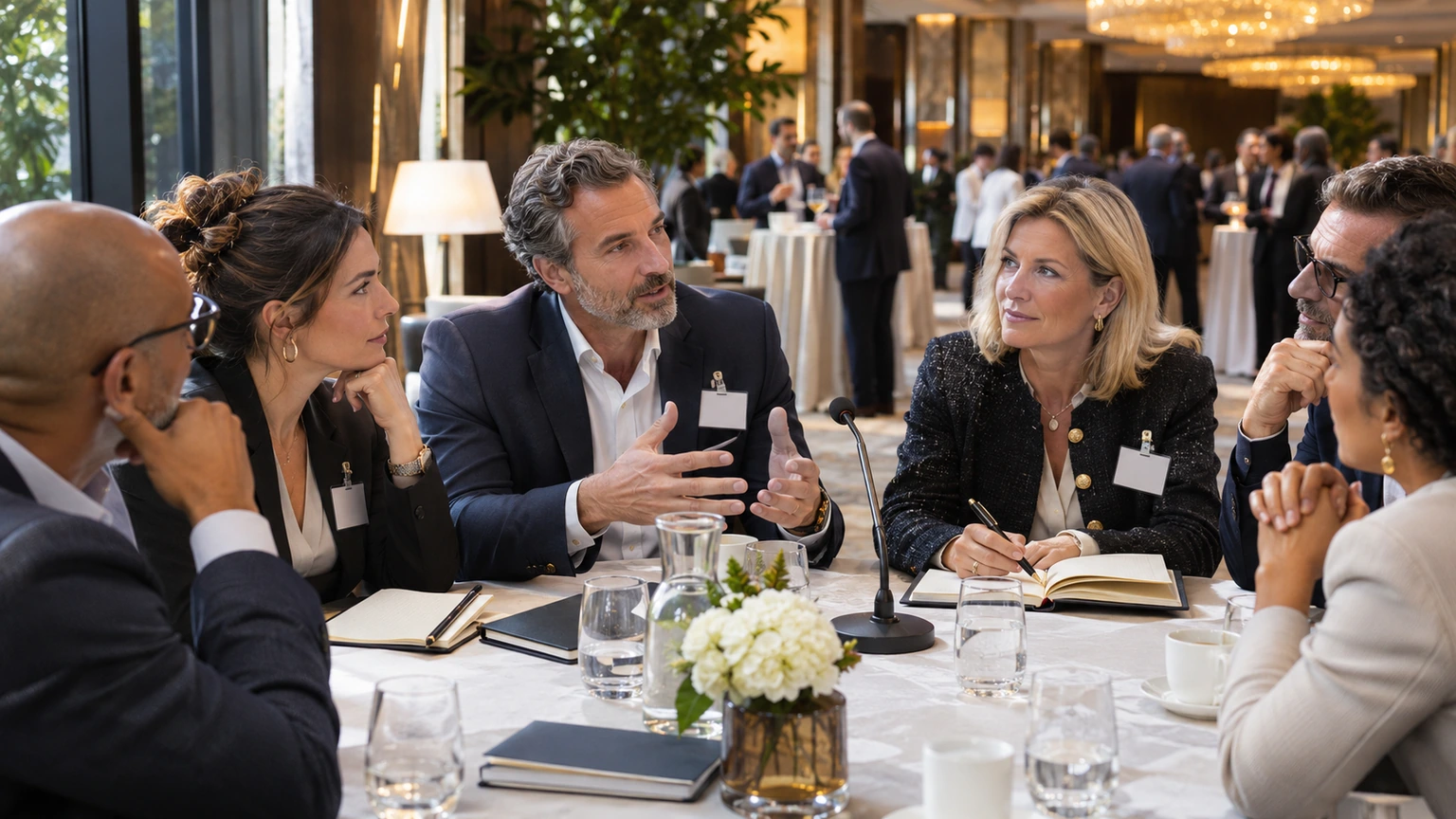
Not every sponsor decision starts with the main event.
Sometimes it starts earlier, in a smaller room, with a sharper audience and a clearer signal of influence.
A recent industry example is coverage of NECLive and The Macallan convening industry leaders ahead of a 2026 conference. That matters because pre-conference executive moments can raise the profile of a flagship event and create a more credible sponsorship story around it.
What it does not prove on its own is that every executive summit will attract premium sponsors, that prestige alone guarantees commercial results, or that a small leadership format automatically strengthens the main event.
An executive summit can create sponsor demand, but only when it is built as part of the event strategy, not as a side event with nicer branding.
Why this matters for event operations
For organisers of premium conferences, sponsor growth often depends on more than booth packages or logo visibility.
Sponsors want access, positioning, relevance, and confidence that the event attracts the right people.
An executive summit can help with that, especially when the flagship event needs stronger top-of-funnel attention among senior buyers, partners, and industry leaders.
Operationally, this affects:
- sponsor package design
- sales timing and pipeline quality
- VIP and hosted guest planning
- speaker and chair engagement
- PR and communications sequencing
- content capture and post-event promotion
- stakeholder confidence ahead of the main event
If handled well, the summit becomes an early proof point. It shows that the flagship event has gravity, not just ambition.
What we can say, and what we cannot
From the source signal, it is reasonable to say that convening senior leaders ahead of a flagship conference can help elevate the event's profile and may improve its sponsorship appeal.
It is also reasonable to say that organisers in premium conference markets should pay attention to pre-event formats that create exclusivity, industry relevance, and stronger executive visibility.
What we cannot say from this source alone is:
- the exact sponsorship outcomes achieved
- which commercial packages were sold
- how the summit was structured operationally
- whether the return came from PR impact, relationship building, or direct sales activity
- that the same approach will work for every event category
That distinction matters. Good event teams should treat this as a strategic signal, then test what fits their own audience and sales model.
The summit is not the result. It is the mechanism that can make the main event easier to sell.
Why executive summits can improve sponsor interest
1. They sharpen the audience story
Many flagship events struggle to explain seniority in a convincing way.
Registration numbers may be strong, but sponsors still ask practical questions: Who will actually be there? How many decision-makers? How much access will we get? Will we be in front of operators, buyers, or only general attendees?
A focused executive summit gives organisers a cleaner answer. It creates a smaller, more curated environment that signals senior participation more clearly than broad audience marketing alone.
2. They create a premium sponsorship layer
Some sponsors do not want the same visibility model as everyone else.
They may be less interested in generic exposure and more interested in leadership association, private access, hosted discussion, or category positioning around decision-makers.
An executive summit can support that higher-value layer if the organiser defines it carefully.
This does not mean overselling exclusivity. It means building a sponsorship offer around real context:
- leadership roundtables
- invite-only networking moments
- content association with senior themes
- hosted dinners or private receptions
- pre-event thought-leadership distribution
3. They give the sales team something concrete earlier
Sponsorship sales often slows down when the flagship event still feels distant.
A pre-conference summit creates an earlier commercial milestone. The sales team can use it to open conversations sooner, create urgency, and demonstrate market momentum before the main programme is fully live.
That helps when sponsors are deciding budgets in stages rather than approving everything at once.
Start with the sponsor objective, not the format
It is easy to copy the idea of an executive summit without being clear on what it is meant to do.
That is where many teams go wrong.
Before designing the format, define the sponsor problem you are trying to solve.
For example:
- do sponsors need stronger access to senior decision-makers
- is the flagship event seen as too broad or too tactical
- does the market need an earlier reason to pay attention
- is your sales team missing a premium product tier
- do you need better proof of industry leadership before launch
Each of those points leads to a different summit design.
If the problem is positioning, the summit should emphasise credibility and content. If the problem is sponsor access, the summit should emphasise curation and relationship design. If the problem is weak launch momentum, the summit should support media, social proof, and outbound sales timing.
What makes the summit commercially useful
Keep the audience intentionally narrow
A summit does not become premium just because attendance is lower.
It becomes valuable when the attendee mix is deliberate.
Organisers should be able to explain why each invited group matters. Senior buyers, strategic partners, policy voices, respected operators, and recognised industry leaders may each play a role, but only if the mix supports the event's sponsor proposition.
If the room feels random, the sponsor story weakens quickly.
Design access carefully
Access is often the main commercial value in an executive setting.
But access has to be structured. If sponsors show up expecting meaningful interaction and receive only stage branding plus unplanned mingling, the experience will feel thin.
Practical design options include:
- moderated small-group discussions
- hosted introductions by the organiser
- private briefing sessions
- clearly timed networking blocks
- post-session hosted conversations with agreed attendee groups
This is where operations matters. Premium sponsor value usually comes from choreography, not from leaving good outcomes to chance.
Connect the summit to the flagship event clearly
The summit should not float separately from the main conference.
It needs a visible link back to the flagship event, otherwise the sponsor may value the summit but still see the larger conference as a different commercial decision.
That link can be created through narrative and workflow:
- announce the summit as part of the wider conference build-up
- carry key themes into the main agenda
- feature summit participants in flagship sessions where appropriate
- use summit outcomes in sponsor sales materials
- turn the summit into an early signal of who the main event is for
How organisers should plan it operationally
1. Build the summit into the sales calendar
If the summit is meant to support sponsorship, it cannot be planned too late.
Your commercial team should know:
- when the summit will be announced
- when sponsor outreach begins
- what inventory is attached to it
- what proof points will be available after it happens
- how it leads into flagship renewal or upsell conversations
This is especially important when premium sponsors need longer approval cycles.
2. Give ownership to one cross-functional lead
Executive formats often fall between departments. Content owns the agenda, sales owns the sponsor conversation, marketing owns the launch, and operations owns delivery.
That split can create a polished event with no clear commercial follow-through.
One lead should own the full operating logic from audience curation through sponsor objective to post-event conversion.
3. Treat invitation strategy as an operating function
For an executive summit, invitation quality is part of the product.
That means guest selection, outreach, acceptance tracking, and host management deserve real process discipline.
Do not treat the invite list as a loose PR exercise. Treat it as a controlled audience build.
4. Plan capture and reuse
If the summit is helping to elevate the flagship event, its value should continue after the room is cleared.
Think in advance about what can be reused:
- short summary insights
- speaker quotes
- theme recaps for sponsor decks
- leadership content for event marketing
- signals of market relevance for prospective partners
The goal is not to overproduce content. The goal is to avoid losing useful commercial evidence.
Where teams should be careful
Executive summits can also disappoint if the format is handled superficially.
Common risks include:
- inviting people based on title alone, without relevance to the event's sponsor market
- promising senior access that is too vague to deliver
- creating a premium format with no clear path into flagship sales
- letting sponsor branding overpower the discussion
- treating media attention as a substitute for measurable sponsor value
There is also a positioning risk. If the summit feels more important than the main conference, the organiser may accidentally fragment the brand rather than strengthen it.
The flagship event should still feel like the destination. The summit should act as the catalyst.
A practical planning checklist
Before launching an executive summit to support sponsorship, ask:
- what sponsor problem is this solving
- which audience segment must be present for the summit to matter commercially
- what type of sponsor value are we actually offering
- how will the summit feed demand for the flagship event
- what evidence will we capture after the summit
- who owns follow-up with sponsors, speakers, and invited executives
- how will we judge success beyond attendance or press mentions
What good looks like
A useful executive summit is not just well attended and well branded.
It does four things clearly:
- it attracts the right senior audience for the event's market
- it gives sponsors a credible and differentiated reason to engage
- it produces usable proof that the flagship event has leadership relevance
- it strengthens, rather than distracts from, the main conference sales story
When those four conditions are met, the summit becomes more than a pre-event extra. It becomes part of the commercial engine.
What this means for event teams
The signal here is straightforward: smaller leadership moments can make larger event sponsorship easier to sell.
But the value does not come from exclusivity alone. It comes from clear audience curation, access design, strong internal ownership, and a direct link to the flagship event's commercial strategy.
For organisers planning premium conferences, the practical question is not whether an executive summit sounds impressive.
It is whether you can make that summit create sponsor confidence, better conversations, and stronger momentum for the main event.
If the answer is yes, it may be one of the most effective ways to improve how your flagship event is positioned before the doors even open.