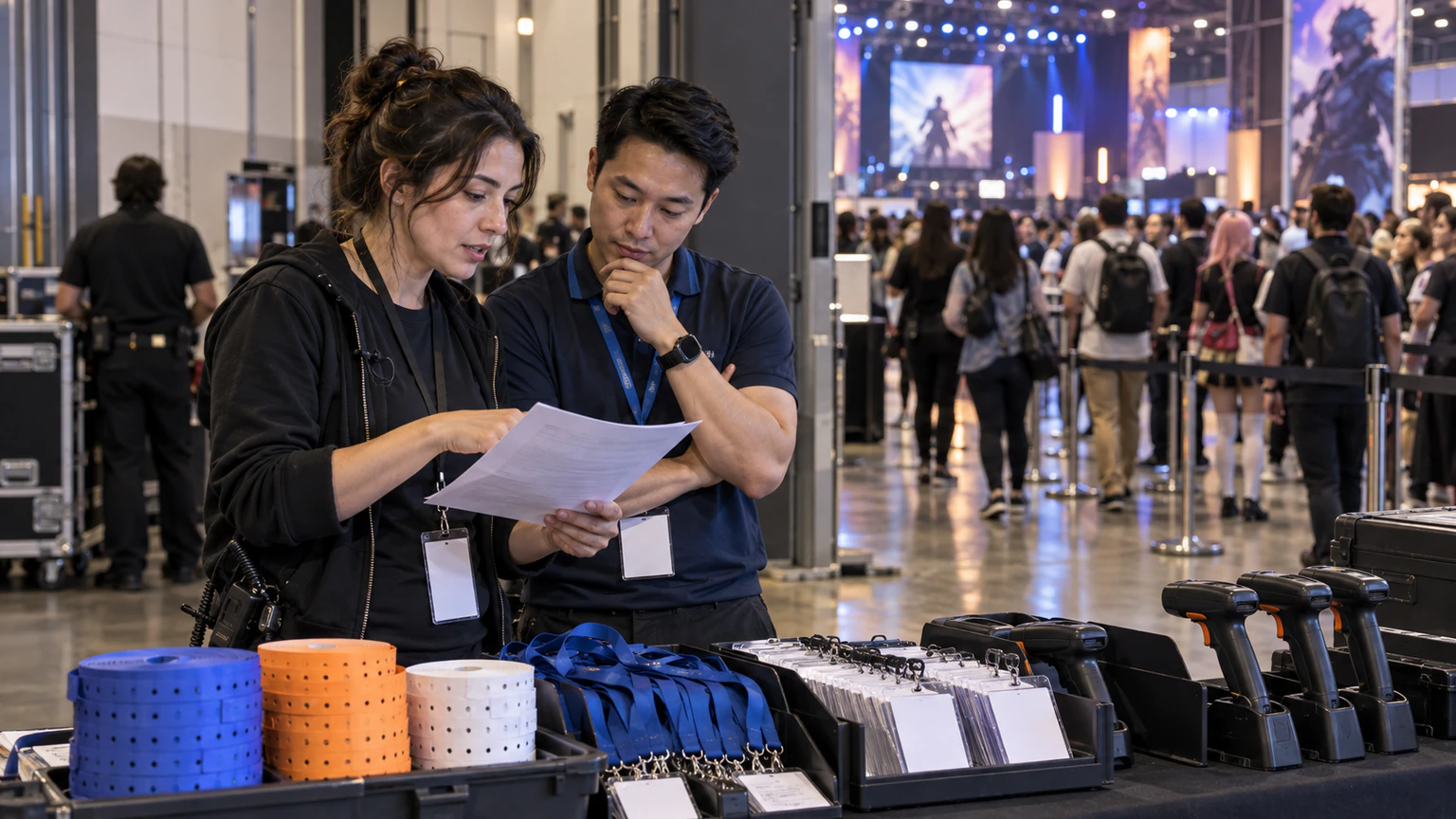

Many event teams are being asked to deliver more without getting much more time, budget, or headcount.
At the same time, attendee expectations keep rising. People expect faster check-in, clearer communication, smoother access, better self-service, and fewer visible mistakes.
That combination changes how event technology should be evaluated.
For lean teams, the question is usually not, “Which platform has the most features?” It is, “Which setup removes the most operational strain?”
When staffing is tight, the most valuable event technology is often the technology that removes repeat work, not the technology that adds more options.
Why this matters
Budget pressure and staffing pressure rarely stay confined to the planning phase. They show up on event day.
Common signs include:
- too many manual updates between teams
- front-line staff relying on workarounds
- slow responses to attendee issues
- last-minute exports, list cleaning, or badge edits
- supervisors acting as human bridges between disconnected workflows
- small mistakes turning into queue delays or service inconsistency
In that environment, buying more technology does not automatically help. If a tool adds setup effort, training burden, or duplicate admin, it can make a lean team less efficient, not more.
What changes when teams are asked to do more with less
A well-staffed event team can sometimes absorb friction. A lean team usually cannot.
When capacity is constrained, every extra handoff matters. Every unclear workflow matters. Every place where staff have to check one system, then update another, matters.
That is why event tech evaluation should start with operational pressure points, not product demos.
Ask first:
- Where does the team lose the most time today?
- Which workflows depend too heavily on manual effort?
- Where do attendee-facing delays usually begin?
- Which tasks create repeat questions for staff?
- What becomes hard to control during peak periods?
Those answers are more useful than a long feature checklist.
Evaluate saved work, not feature volume
Feature-heavy evaluations often miss the real issue: whether the team will actually save work during planning and live delivery.
A practical review should focus on labor reduction in real workflows.
Look for time removed from repeat tasks
Start with the tasks that happen frequently and consume attention.
Examples might include:
- updating attendee records
- managing access changes
- sending routine attendee information
- checking eligibility or status at service points
- reconciling on-site actions after the fact
If a tool improves one impressive edge case but leaves daily operational work untouched, it may not help a constrained team very much.
Look for fewer handoffs
Every handoff creates delay and risk.
If one team has to collect information, another has to clean it, and a third has to apply it on site, the process is fragile. Lean teams benefit most from workflows that reduce those transitions.
Practical questions include:
- Can staff complete the task in one place?
- Will supervisors need to intervene often?
- Does the process depend on side spreadsheets or message threads?
- Can front-line teams get the answer they need without escalation?
Saved work is not only about speed. It is also about reducing the number of chances for confusion, duplication, and missed updates.
Look for cleaner live operations
Some tools look efficient during setup but create stress on event day.
Event teams should evaluate what happens under live pressure:
- during peak arrival windows
- during shift changes
- when attendee records need correction
- when access rules are questioned
- when queues start forming
- when staff need to explain the process quickly
If the workflow becomes slower or harder to explain at the exact moment volume rises, the operational value may be weaker than it first appears.
Where lean teams should be especially careful
Under pressure, it is easy to be drawn toward broad promises. That is where teams need discipline.
1. Do not confuse more features with more usable value
A larger feature set can sound safer in procurement discussions, but unused or rarely used functionality still creates cost. It can increase implementation complexity, training needs, and internal decision fatigue.
For many teams, a simpler workflow that staff can run confidently is more valuable than a larger toolkit that only a few people understand.
2. Do not ignore setup and training effort
The real cost of event technology is not only the line item. It includes:
- configuration time
- process redesign
- staff training
- testing
- troubleshooting
- workarounds needed when teams are under time pressure
If a platform requires heavy internal effort just to become usable, lean teams should count that honestly.
3. Do not evaluate only for planning, evaluate for event day
Some buying decisions are made too far from live operations.
A process may seem manageable in a calm planning environment, then become difficult in front of attendees. Event-day usability matters more than theoretical completeness.
A practical evaluation framework for constrained teams
If budgets are tight and staffing is stable, a useful review can be built around a few operational questions.
Can it reduce front-line dependency on memory?
The more staff have to remember rules, exceptions, or status checks manually, the more inconsistent service becomes.
Lean teams should favor workflows that make the right action easier to follow in the moment.
Can it reduce post-event reconciliation work?
A common hidden burden is the cleanup that happens after live delivery: correcting records, validating actions, reconciling exceptions, and resolving what happened at different service points.
Technology that reduces that cleanup can create real labor value, even if that benefit is less visible in a sales conversation.
Can it help temporary or rotating staff perform reliably?
Many events depend on short-term staff, volunteers, agency workers, or rotating shifts. Tools that require deep institutional knowledge are harder to operate consistently.
Simple, clear workflows are often more resilient.
Can it hold up during peak volume?
Evaluate the busiest moments, not just average conditions.
Ask what the process looks like when:
- attendees arrive all at once
- multiple service desks need the same information
- exceptions rise
- supervisors are already occupied
- staff have seconds, not minutes, to respond
This is usually where true operational value becomes obvious.
How to make the buying conversation more grounded
Lean teams often need to justify technology decisions internally. The strongest case is usually operational, not abstract.
Instead of centering the discussion on feature breadth, frame it around outcomes such as:
- fewer manual steps per attendee workflow
- less staff intervention needed at service points
- reduced queue risk during peak periods
- fewer duplicate records or status errors
- less reliance on side processes outside the main workflow
- less end-of-day or post-event reconciliation work
That language is often easier for operations leaders to defend because it ties technology choice to workload, consistency, and delivery risk.
Common mistakes to avoid
- buying for the widest possible feature list instead of the most important workflows
- underestimating the labor needed to configure and maintain the process
- treating front-line usability as a secondary concern
- assuming a manual workaround is acceptable because it only affects a few cases
- failing to review how the tool performs under peak event conditions
- letting procurement priorities outweigh operational realities
What this means for event teams
Budget pressure and staffing pressure are not temporary inconveniences for many organizers. They are shaping how events get delivered.
That makes event tech evaluation more practical, not less.
For lean teams, the best choice is often the one that reduces repeat work, simplifies execution, and helps staff deliver a more consistent attendee experience under pressure.
In other words, evaluate technology like an operations decision. Because that is what it is.