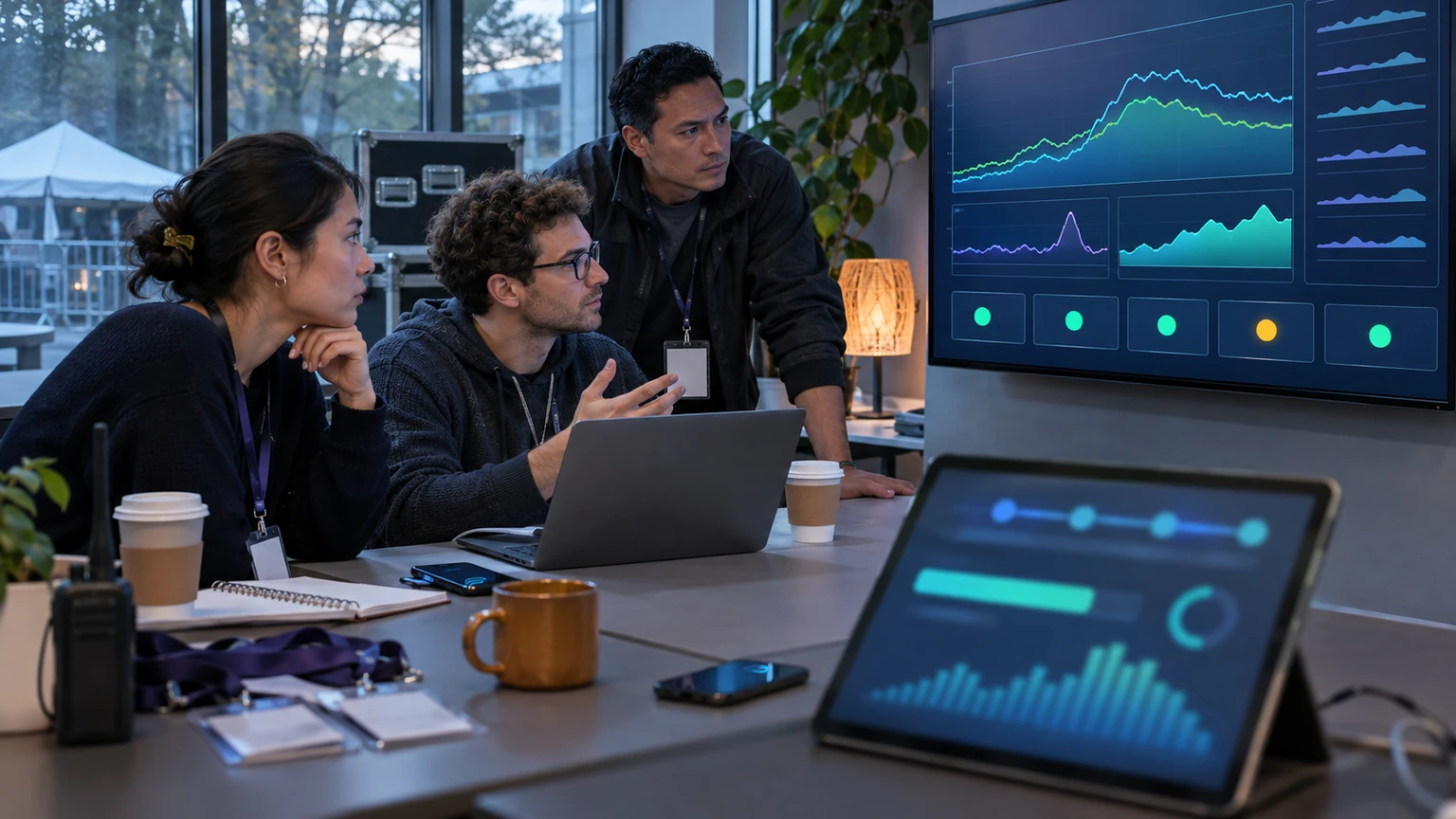
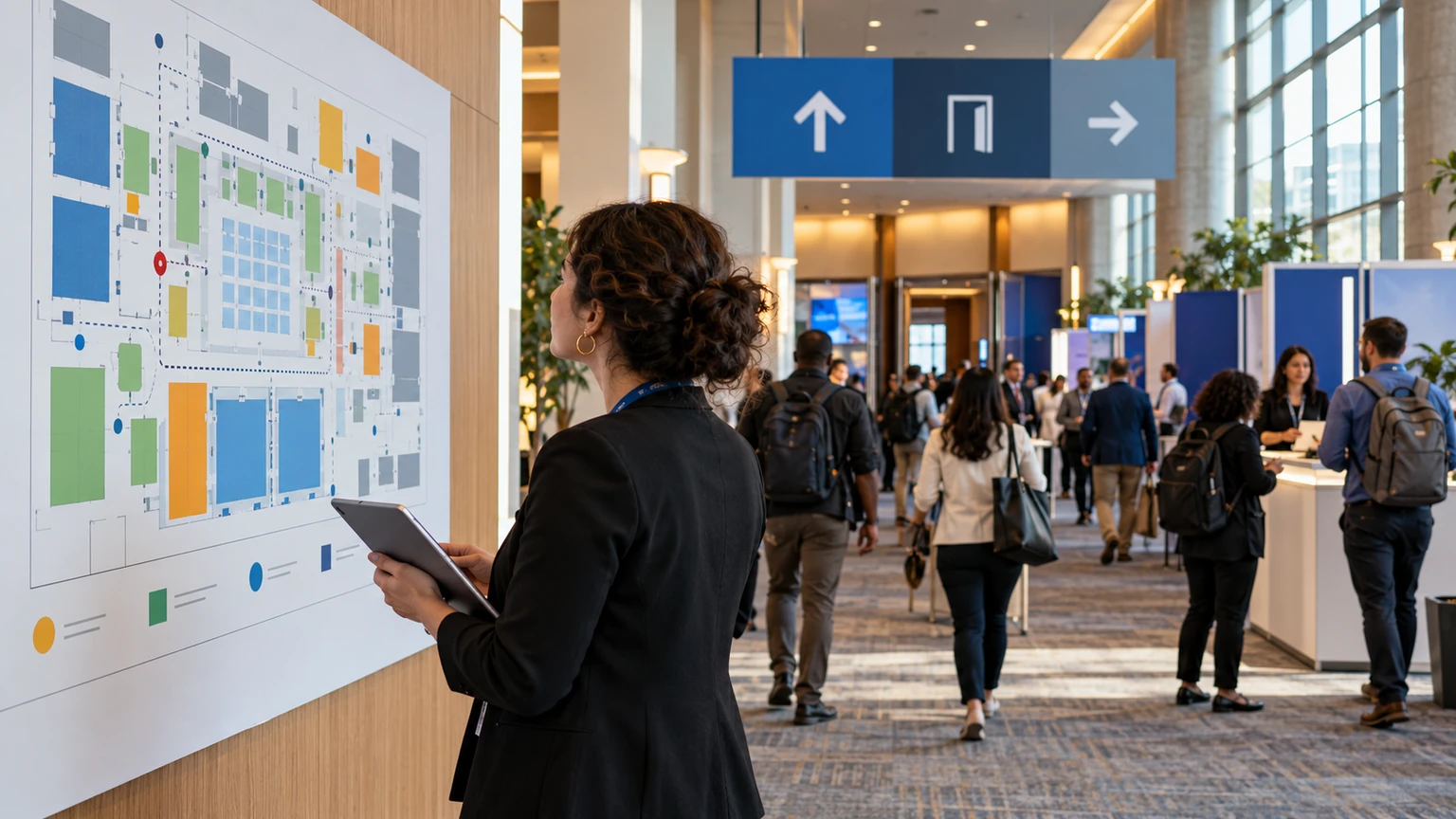
Venue maps are often treated as a design asset. In practice, they are an operations tool.
That is why the reported launch of Nextech3D.ai’s AI-native Map D is worth attention. The public signal suggests growing interest in applying agentic AI to event mapping, venue planning, and attendee navigation.
For organisers, venue teams, and event app owners, the useful question is not whether AI sounds impressive. It is whether AI-native mapping can reduce friction in the real work of helping people move, find, decide, and respond on-site.
A map becomes operationally valuable when it helps people take the next right action quickly, not just when it looks detailed.
Why this matters for event operations
Navigation problems are rarely isolated problems. When attendees cannot find entrances, session rooms, exhibitor booths, help desks, or food areas, the effect spreads across the event.
Teams usually feel that pressure in familiar places:
- late arrivals to sessions
- crowding at information points
- repeated support questions
- reduced exhibitor footfall in harder-to-find areas
- frustration inside event apps
- staff time spent redirecting people manually
- weaker sponsor and attendee experience overall
At larger venues, even a decent static map may not be enough. People need orientation, route logic, and quick answers in context.
What the public signal tells us, and what it does not
From the source idea provided, the confirmed signal is narrow but useful: Nextech3D.ai has unveiled an AI-native Map D product, and the positioning links it to agentic AI in the event industry.
That is enough to support a grounded discussion about where AI-native mapping may fit into venue planning and attendee navigation.
What this does not confirm on its own is:
- how well the product performs in live event conditions
- which exact workflows it supports in production
- whether it improves attendee outcomes compared with standard mapping tools
- what implementation effort organisers should expect
- how easily it fits into an existing event app or venue stack
That distinction matters. A product launch is a meaningful market signal, but it is not evidence that every AI-led mapping approach is already proven at event scale.
Evidence-aware event teams should treat new AI mapping launches as prompts for structured evaluation, not automatic adoption.
What “AI-native mapping” usually implies
In practical terms, AI-native mapping suggests that the map is not only a visual layer. It may also act as an interactive decision layer, helping users ask questions, find locations, and move through a venue with more context than a static floorplan can provide.
For event teams, that idea matters because mapping sits close to several live workflows:
- attendee wayfinding
- agenda-to-room navigation
- exhibitor discovery
- staff routing and support
- access to amenities and service points
- last-minute communication when layouts or room use change
The operational promise is simple: less searching, less confusion, and fewer avoidable interruptions.
Where AI-native mapping could be useful
1. Helping attendees find the next destination faster
The clearest use case is attendee navigation. A conventional map may show where things are. A more intelligent mapping layer may be more useful if it helps answer practical questions such as where a room is, how to get there, and what is nearby.
This matters most when events have:
- multiple halls or floors
- dense session schedules
- large expo footprints
- temporary room naming or changing layouts
- mixed audience types, including first-time visitors
If people spend less time interpreting the map, they have more time engaging with the event itself.
2. Improving exhibitor visibility
Exhibitors often care less about whether they are listed on a map and more about whether attendees can actually find them.
Better mapping can support exhibitor outcomes by making booth discovery easier, especially in larger shows where some aisles naturally receive less traffic than others. For organisers, this is not just a convenience feature. It affects exhibitor satisfaction and perceived event value.
A practical review question is: does the mapping experience help attendees move with intent, or does it simply display hall geometry?
3. Reducing pressure on staff and help desks
Wayfinding problems create repetitive operational load. Staff get asked the same questions, information desks become congested, and teams spend time solving avoidable issues.
If a mapping layer can answer common navigation questions more clearly, it may reduce some of that pressure. That does not remove the need for staffed support, but it can make support more focused on exceptions rather than basics.
4. Supporting venue planning before the event opens
The mapping conversation should not start on opening day. Planning teams can also use mapping logic earlier, when they are deciding how the venue will actually function.
For example, organisers should think about:
- whether session rooms are intuitively placed
- where congestion is most likely
- how far key destinations are from entrances
- whether sponsors and exhibitors are distributed fairly
- where food, rest, and support areas sit in relation to traffic flow
Even without claiming specific AI planning capabilities, it is reasonable to say that better mapping should support better layout thinking.
Why static maps often fall short
Static maps still have value. They are familiar, simple to publish, and useful as a baseline reference.
But they often struggle when the event environment is busy or changeable. Attendees do not only need location data. They need usable context.
Static mapping can fall short when:
- the venue is large or multi-level
- the user does not know their current position clearly
- room assignments change
- the event agenda is closely tied to movement
- exhibitor discovery matters as much as room finding
- the audience includes international or first-time visitors
In those conditions, the best map is usually the one that reduces decision effort.
How organisers should evaluate AI-native mapping practically
Start with the operational problems
Do not begin with the AI label. Begin with the navigation issues your event already has.
Useful questions include:
- Where do attendees most often get lost or delayed?
- Which locations generate the most support questions?
- Do exhibitors complain about discoverability?
- How often do layout or room changes create confusion?
- How important is map usage inside the event app journey?
If the team cannot define the current friction clearly, it will be difficult to judge whether a new mapping approach is improving anything meaningful.
Review fit with the attendee journey
Mapping should support the moments that matter most:
- arrival at the venue
- moving from check-in to first destination
- finding sessions quickly between agenda blocks
- discovering exhibitors or sponsored areas
- locating services such as food, restrooms, and help desks
- navigating end-of-day exits or transport points
If the mapping experience is disconnected from those moments, it may stay underused even if the technology is capable.
Check ownership and update workflow
One of the biggest operational questions is simple: who keeps the map accurate?
Before adoption, teams should define:
- who owns map data
- who approves location naming
- how updates are handled close to show days
- how room moves or exhibitor changes are reflected
- who supports attendees when digital guidance is not enough
Good mapping depends on governance as much as interface quality.
Test it in live-event conditions
Event technology should be judged under event pressure, not only in a calm demo. That means reviewing how the mapping experience performs when users are rushed, distracted, and relying on incomplete information.
A practical test should consider:
- speed of finding a destination
- clarity for first-time users
- ease of use on mobile
- performance when many attendees are active at once
- ability to support last-minute changes cleanly
Where organisers should be careful
AI-native mapping may be promising, but there are common mistakes to avoid.
- Do not confuse novelty with usefulness. A smarter map still has to solve everyday wayfinding problems clearly.
- Do not overestimate automation. Live events still need human oversight, especially when layouts, naming, and traffic realities change.
- Do not ignore data quality. Inaccurate room names, outdated exhibitor locations, or weak update processes will undermine any mapping experience.
- Do not treat mapping as separate from the app journey. Navigation works best when it connects naturally to agenda, exhibitor, and support information.
- Do not assume every event needs the same depth. A compact single-floor conference may need something very different from a large expo campus.
A practical review model for event teams
If you are assessing AI-led mapping options, keep the review simple and operational:
- List the top five navigation problems from your last event.
- Map those problems to attendee, exhibitor, and staff impact.
- Define which journeys matter most: arrival, session finding, expo discovery, service access, or all four.
- Review how easily the mapping layer can be kept accurate before and during the event.
- Test whether it reduces effort for real users, not just internal stakeholders.
- Decide whether the value is strong enough for your event size, venue complexity, and team capacity.
What good looks like
Good event mapping does not need to feel futuristic. It needs to feel dependable.
Attendees should be able to move with confidence. Exhibitors should feel discoverable. Staff should spend less time answering basic direction questions. Organisers should be able to adjust when the plan changes.
If AI-native mapping contributes to those outcomes, it is worth serious attention. If it only adds technical complexity without reducing confusion, its value will be limited.
What this means for event teams
The reported launch of AI-native Map D is a useful signal that mapping is becoming a more strategic part of event technology, not just a visual add-on.
For Bewitt’s audience, the practical takeaway is clear: wayfinding should be treated as an operational workflow. As event apps, venue systems, and attendee expectations become more connected, mapping will matter more, especially in larger and more dynamic environments.
The right response is not to assume that every new AI mapping product is proven. It is to evaluate whether a more intelligent mapping layer can make venue planning clearer and attendee navigation easier in the events you actually run.