
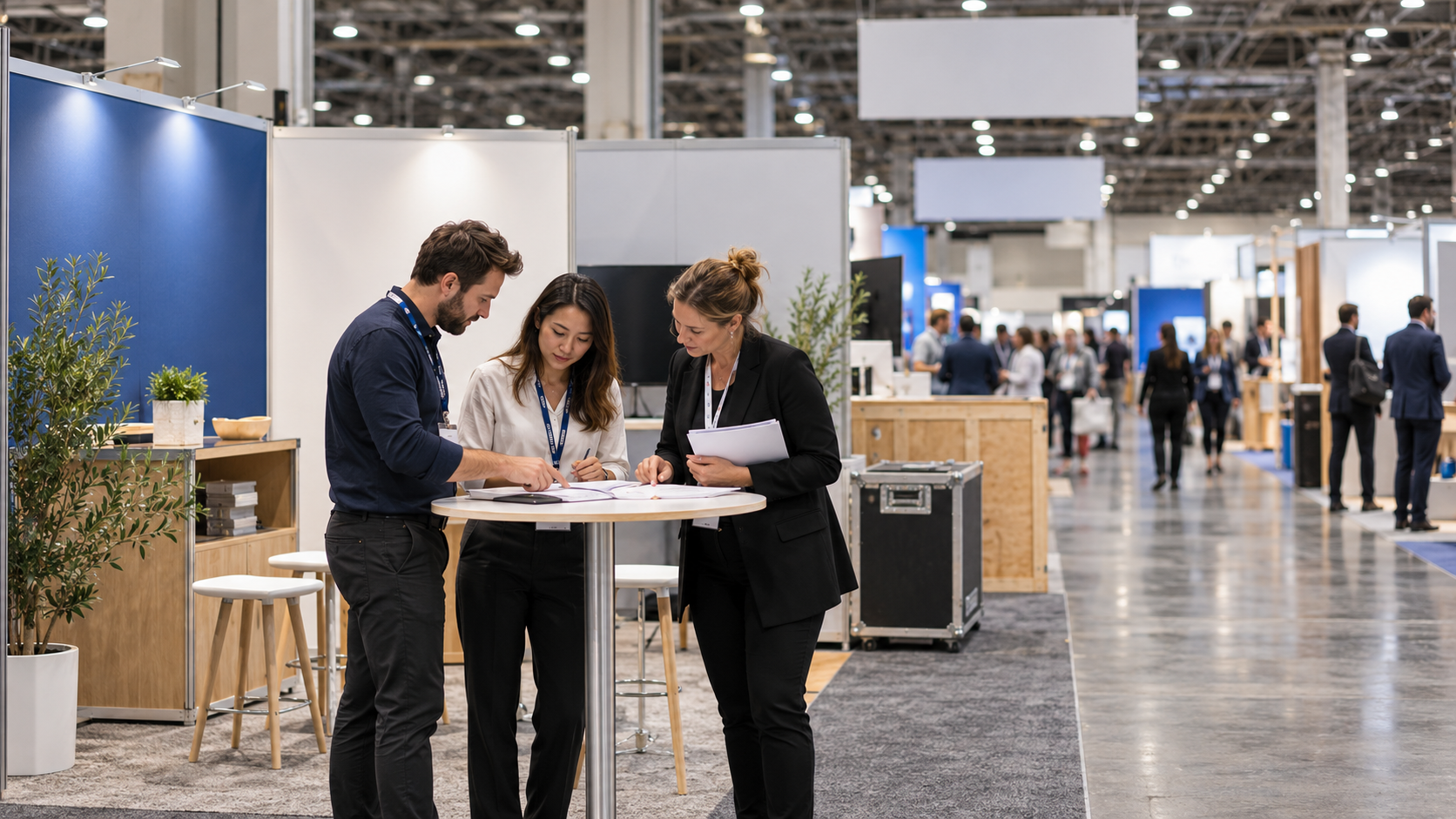
Trade show teams often start with a simple question: how big should the booth be?
In practice, that is not really a size question. It is an ROI question. The right booth is the one that supports your goals, fits your budget, and can be staffed and operated properly on site.
A useful public signal here is the USDA Foreign Agricultural Service coverage of a supermarket trade show and its practical exhibitor guidance. That matters because trade show performance is rarely decided by stand design alone. Cost, staffing, product fit, and how the team works the floor all shape the outcome.
For exhibitors, organisers, and venue teams, the practical question is not whether a larger booth looks more impressive. It is whether the booth footprint matches the level of activity, traffic, and commercial purpose the team can realistically support.
A booth creates value when the space, people, and plan work together. More square metres alone do not guarantee more return.
Why this matters for event operations
Booth decisions affect far more than exhibitor spend. They shape installation timelines, staffing plans, traffic flow, meeting quality, lead handling, and the pressure placed on organisers during the show.
When booth planning is misaligned, problems usually show up in familiar places:
- overspending on space that does not produce enough meaningful interactions
- understaffed booths that miss traffic peaks
- cluttered stands that look busy but do not support good conversations
- meeting areas that are too small for the intended buyer mix
- product displays that are expensive to build but hard to demonstrate
- poor follow-up because lead capture and team roles were not defined clearly
That is why booth ROI should be treated as an operating model decision, not just a marketing or design choice.
What the public signal tells us, and what it does not
From the source idea provided, the confirmed signal is modest but useful: practical trade show guidance, including cost and staffing considerations, remains relevant enough to appear in public-facing government and industry coverage.
That is enough to support a grounded discussion about booth planning, exhibitor budgeting, and on-site execution.
What this does not confirm on its own is:
- one ideal booth size for every exhibitor
- that larger booths always outperform smaller ones
- that a single budgeting ratio applies across all sectors and venues
- which specific trade show tactics produce the best ROI in every category
- that visual impact automatically leads to qualified business results
That distinction matters. A practical source can point event teams toward better planning, but it does not justify one fixed formula for every exhibition environment.
Evidence-aware trade show planning starts with the job the booth must do, then works back to space, cost, and staffing.
Start with the purpose of the booth
Before comparing booth sizes or build costs, define the primary purpose of the stand. Many teams skip this step and move straight to layout discussions.
In reality, a booth can be designed for very different outcomes:
- lead generation at volume
- high-value buyer meetings
- product sampling or demonstration
- brand presence in a strategic market
- distributor or partner conversations
- market research and relationship building
Each of these goals points to a different footprint and operating setup.
A booth aimed at quick lead capture may need open access, strong visibility, and clear messaging. A booth aimed at buyer meetings may need fewer walk-up interactions but more seating, privacy, and a disciplined schedule.
Booth size should follow activity design
A larger stand can be useful, but only when there is a clear reason for the extra space.
Useful planning questions include:
- How many simultaneous conversations do you expect?
- Will products be displayed, sampled, or demonstrated?
- Do you need storage, prep, or back-of-house space?
- Will key meetings be scheduled in advance?
- Can the team keep the booth active for the full show day?
If the answer to most of those questions is no, a smaller booth may be the more efficient choice.
Many exhibitors get better results from a compact, well-run stand than from a large space that feels empty or difficult to manage.
Think in total cost, not space cost alone
Floor space is only one part of the booth budget. Total booth cost usually includes many other elements that directly affect ROI.
- space rental
- stand design and construction
- shipping or freight
- installation and dismantle labour
- power, cleaning, and venue services
- travel and accommodation
- staff time
- samples, demos, or promotional materials
- lead capture and follow-up work after the event
This matters because a cheaper footprint can still become expensive if the booth requires a heavy build, complex logistics, or an oversized travel team.
Likewise, a more expensive location or larger format may be justified if it supports stronger buyer access and measurable commercial outcomes.
Staffing is part of booth ROI
One of the most common trade show mistakes is treating staffing as a secondary issue. A booth is only as effective as the team operating it.
Strong staffing plans usually answer four questions:
- Who is responsible for greeting and qualifying visitors?
- Who handles product explanation or demonstrations?
- Who takes scheduled buyer meetings?
- Who records leads and next steps accurately?
If those roles are unclear, traffic can build without producing useful outcomes.
Understaffing creates visible gaps: visitors wait, conversations end abruptly, and high-value prospects leave unqualified. Overstaffing creates a different problem: too many people inside the stand, internal chatter, and less room for visitor engagement.
Match booth design to buyer behaviour
Not all footfall has the same value. Planning should reflect how target visitors actually move and decide at the show.
For example:
- if buyers browse quickly, the booth needs immediate clarity
- if products require explanation, the team needs space to demonstrate them
- if meetings are pre-booked, the stand must support punctual handoffs
- if the audience values tasting, testing, or samples, flow needs to support repeat short interactions
This is where organisers and exhibitors often benefit from the same mindset: design around behaviour, not just appearance.
How exhibitors can assess likely ROI before the show
Pre-show ROI planning does not need to be overly complex. It does need to be honest.
Useful inputs include:
- target number of qualified conversations
- expected number of scheduled meetings
- average value of a realistic post-show opportunity
- cost per lead or cost per meaningful meeting
- markets or buyer types that matter most this year
- whether the goal is immediate sales, pipeline creation, or strategic visibility
This will not produce a perfect forecast. It will, however, make space decisions more disciplined.
If a larger booth only works financially under overly optimistic assumptions, that is a warning sign before contracts are signed.
What organisers should pay attention to
For organisers, booth ROI matters because exhibitor results affect renewals, floorplan demand, and the overall quality of the event.
Organisers can support better exhibitor outcomes by making it easier to plan realistically:
- provide clear information on booth dimensions, services, and deadlines
- share expected audience profile and traffic patterns as accurately as possible
- help exhibitors understand sponsorship and visibility options beyond raw booth size
- offer practical guidance for first-time exhibitors
- design floorplans that do not leave smaller exhibitors invisible by default
When exhibitors understand what they are buying and how the floor works, they are more likely to size their presence sensibly.
When a smaller booth can outperform a larger one
A smaller booth often produces better ROI when the team has a clear message, a tight meeting plan, and enough staff discipline to handle traffic well.
This is especially true when:
- the product offer is easy to explain quickly
- the event is mainly for meetings rather than broad public engagement
- the exhibitor is testing a market
- budget should be preserved for travel, sampling, or follow-up
- the team wants to learn before scaling presence next year
Smaller booths also force clarity. They reduce the temptation to fill space with elements that look impressive but do little operationally.
When paying for more space may be worth it
Extra space can be justified when the booth needs to support more than passive visibility.
That may include:
- multiple product zones
- live demonstrations
- hosted buyer meetings
- sampling activity with queues or dwell time
- private conversations with distributors or major accounts
- shared presence across several brands or product lines
In those cases, more space is not just a branding choice. It becomes part of the delivery model.
The key is that the operating plan must be strong enough to use that space productively across the full event.
Where teams should be careful
Trade show ROI is easy to overstate when measurement is weak. Booth performance should not be judged only by walk-up traffic, badge scans, or comments that the stand looked busy.
Common pitfalls include:
- treating every lead as equal
- failing to separate curiosity from buying intent
- counting activity without defining next steps
- ignoring staff and logistics cost in the final ROI view
- assuming visual prominence means commercial success
A crowded booth may still underperform if the right buyers were not engaged or if follow-up breaks down after the show.
A practical review model for exhibitors
After the event, review booth performance with a simple structure:
- What was the booth supposed to achieve?
- Did the chosen size support that goal well?
- Was the team staffed correctly for peak periods?
- Which interactions were genuinely qualified?
- What was the full cost of participation?
- What should be smaller, larger, simpler, or better timed next time?
This kind of review matters more than whether the booth looked successful in photos.
What good looks like
Good booth ROI usually looks fairly simple:
- a stand sized for its real purpose
- a budget that includes total operating cost, not just footprint
- enough staff to engage visitors properly
- clear visitor flow and clear messaging
- defined success measures before the show opens
- disciplined follow-up after the event ends
That is true for large exhibitors, small exporters, first-time brands, and repeat show participants alike.
What this means for event teams
The best trade show booths are not always the biggest, and they are not always the cheapest. They are the ones planned with operational realism.
For exhibitors, that means choosing a footprint that the team can afford, staff, and activate well.
For organisers, it means helping exhibitors make better decisions, because exhibitor ROI is closely tied to event retention and floor health.
In the end, booth planning works best when size, impact, and cost are treated as connected decisions. That is where practical ROI starts.