
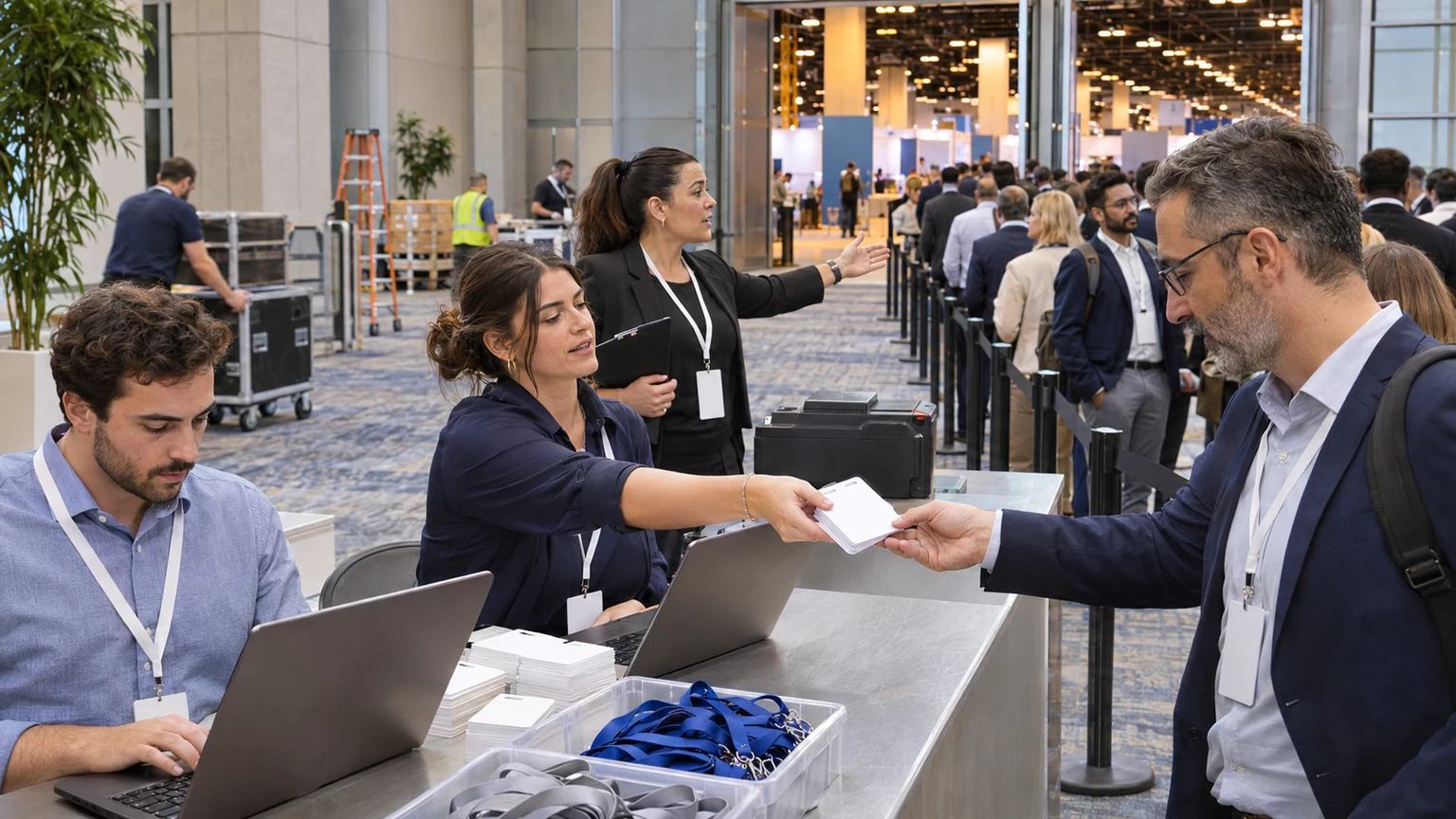
Large trade shows rarely struggle because demand exists. They struggle when operational complexity grows faster than the systems around it.
That is why reporting around PACK EXPO Southeast returning, with registration open for 2027, is useful beyond the headline itself. For organisers, it is a reminder that exhibitor onboarding and ticketing need to work at scale, not just look complete on paper.
When a show grows, or is preparing for another large cycle, friction tends to appear in the same places: package selection, staff registration, badge allocation, approvals, deadline management, and on-site exception handling.
What this does not prove on its own is which exact workflow any one organiser is using, what technology stack sits underneath, or which specific process changes will produce the best result for every show.
At scale, onboarding is not just account setup and ticketing is not just badge issuance. Both are operational systems that shape exhibitor confidence before the event even starts.
Why this matters for event operations
Exhibitors interact with an event differently from standard attendees.
They usually have more tasks, more deadlines, more stakeholders, and more reasons to contact support. One company may need to register stand staff, assign badge types, confirm billing details, upload compliance documents, request services, and manage late changes, all before build-up begins.
If these workflows are unclear, the impact spreads quickly:
- support volume increases before the show
- badge errors appear closer to move-in and opening day
- sales and operations teams spend time resolving preventable issues
- exhibitors feel uncertain about what is complete and what is missing
- on-site desks become overloaded with avoidable exceptions
- the event starts with more friction for exhibitors, staff, and contractors
For trade show organisers, smoother onboarding and ticketing are not minor admin wins. They protect the whole operating rhythm of the event.
What we can say, and what we cannot
From the source signal, it is reasonable to say that trade show activity remains strong enough for large-scale registration and exhibitor operations to stay highly relevant. It is also reasonable to say that organisers planning future editions should be reviewing whether their onboarding and ticketing workflows are ready for volume, complexity, and deadlines.
It is further reasonable to say that sector events like PACK EXPO Southeast help illustrate a common challenge in trade shows: exhibitor management often becomes harder before attendee-facing problems become visible.
What we cannot say from this source alone is:
- the exact registration architecture used by the event
- how exhibitor onboarding is currently sequenced
- which tasks are automated and which are manual
- what completion rates, support loads, or badge error rates look like
- whether one specific software approach is responsible for better outcomes
That distinction matters. Event teams should treat the market signal as a prompt to tighten workflows, not as proof that one event or one tool has already solved the problem.
The practical question is simple: can exhibitors complete what they need quickly, accurately, and without repeated help from your team?
Start with the exhibitor task map
Many organisers design exhibitor onboarding around internal departments. That is understandable, but it often creates a fragmented experience.
A better approach is to map the workflow from the exhibitor's point of view.
In most trade shows, that map includes a familiar sequence:
- confirm participation and package details
- set up the primary exhibitor contact
- invite additional staff or team admins
- allocate passes or badge entitlements
- collect company and profile information
- complete required operational tasks and deadlines
- manage changes close to the event
- resolve exceptions on site
When these steps are split across too many disconnected messages, portals, or spreadsheets, exhibitors start guessing what matters most. That is where errors begin.
The task map should show one thing clearly: what has to happen next, by whom, and by when.
Where onboarding usually breaks first
1. Ownership is unclear
Many exhibitor accounts have one initial contact, but several people handling different jobs. Marketing may want profile access, operations may need manuals, and HR or sales may be assigning badges.
If role ownership is not clear, tasks stall.
Organisers should define:
- who the primary account owner is
- who can invite or manage additional users
- who controls badge allocation
- which tasks require specific permissions
- how handover works if the main contact changes
This sounds basic, but it reduces a surprising amount of support traffic.
2. Ticket types become harder to understand at exhibitor level
Attendee ticketing and exhibitor ticketing are often treated as similar. Operationally, they are not.
Exhibitors may be dealing with staff badges, contractor access, guest invitations, hosted buyer passes, or quota-based entitlements linked to package level. If the rules are hard to interpret, exhibitors either delay action or assign the wrong passes.
At scale, clarity beats flexibility that nobody understands.
Good practice usually means:
- plain-language badge descriptions
- simple eligibility rules
- visible usage counts or remaining allocations
- clear distinction between internal staff and external guests
- obvious escalation routes for exceptions
3. Deadline communication is too fragmented
Exhibitors often miss deadlines not because they do not care, but because the deadlines live in too many places.
One email mentions registration, another mentions directory listing, another mentions build documents, and another comes from a contractor or service partner. From the organiser side, this may feel complete. From the exhibitor side, it feels noisy.
A stronger approach is to consolidate critical actions into a visible schedule with status indicators and consequence-based wording. Tell exhibitors what matters now, what is next, and what happens if they leave it late.
Design ticketing for exception control, not only happy-path speed
Most registration flows look acceptable when everything goes right.
The real test is what happens when the data is messy, the company changes staff late, or someone arrives on site without the correct badge assignment.
Trade show ticketing at scale should be designed around exceptions as much as throughput.
That means planning for cases like:
- a team member is replaced two days before the event
- an exhibitor exceeds badge entitlement and needs approval
- a contractor arrives without the right access category
- duplicate records create check-in confusion
- an exhibitor contact registered the wrong people under the wrong type
- finance or package disputes affect badge release
If these situations always require manual intervention from a senior staff member, scale will expose the weakness quickly.
Build a tiered support model before demand spikes
Not every exhibitor question needs the same response path.
A practical support model separates routine requests from operational risks.
Tier 1: self-service answers
Use clear guidance for common tasks such as badge assignment, entitlement rules, edit windows, and deadlines.
Tier 2: managed support
Handle account issues, role problems, invoice-linked questions, and controlled changes through a standard team process.
Tier 3: escalation
Reserve experienced staff for cases that affect access, compliance, move-in readiness, or opening-day risk.
This structure helps teams protect capacity in the final run-up, when volumes rise and patience falls.
How to make exhibitor onboarding more scalable
Scalability usually comes from workflow discipline more than feature count.
Organisers should focus on a few fundamentals:
- Reduce duplicate data entry: do not ask exhibitors for the same information in multiple places unless there is a real operational reason.
- Sequence tasks clearly: some tasks depend on earlier steps. Make that visible instead of letting exhibitors discover it by trial and error.
- Use status visibility: exhibitors should be able to tell what is done, what is pending, and what is blocked.
- Separate required from optional actions: this lowers confusion and helps exhibitors prioritise correctly.
- Define edit rules: tell users what they can still change, and when changes become restricted.
- Prepare on-site fallbacks: even good systems need a controlled process for exceptions at the venue.
These are not glamorous improvements, but they usually produce the most reliable operational gains.
A practical checklist for organisers
Before registration volume rises, event teams should review the workflow with operational pressure in mind.
- Can a new exhibitor understand the first three actions without contacting support?
- Are badge types easy to distinguish?
- Can one exhibitor company manage multiple internal users cleanly?
- Do exhibitors know who owns each task on their side?
- Are deadlines consolidated and prioritised?
- Can staff see incomplete, blocked, or high-risk accounts early?
- Is there a clear rule for late badge changes?
- Can on-site teams resolve common exceptions quickly?
- Are support and sales teams working from the same account picture?
- Have you tested the process with a real exhibitor scenario, not just an internal walkthrough?
Where teams should be careful
In large trade shows, organisers often try to solve complexity by adding more instructions. That can make the workflow harder, not easier.
Teams should be careful about:
- overloading exhibitors with long guidance before they know what matters
- using internal event language that exhibitors do not naturally understand
- treating every account as if it has the same structure or staffing model
- waiting too long to identify incomplete or inactive exhibitors
- assuming that successful attendee registration means exhibitor registration is also healthy
- pushing too many exceptions into on-site resolution
By the time badge desks become the place where unresolved exhibitor issues surface, the cost of friction is already much higher.
What good looks like
Good exhibitor onboarding feels controlled, not complicated.
Exhibitors know what they bought, what they can allocate, what deadlines matter, and what still needs attention. Internal teams can see risk early. On-site staff inherit fewer surprises. Badge issuance becomes faster because most corrections were handled before arrival.
Most importantly, exhibitors feel that the organiser is running a serious operation.
That confidence matters commercially as well as operationally. It affects renewal conversations, stand team satisfaction, and how easy the next edition will be to sell.
What this means for event teams
The useful lesson from trade show signals like PACK EXPO Southeast is not simply that large events continue to attract interest. It is that scale rewards operational clarity.
For organisers, the priority is not adding more process for its own sake. It is building onboarding and ticketing flows that help exhibitors complete the right tasks with less confusion and fewer interventions.
If your team is planning the next large event cycle, this is a good time to review the exhibitor journey end to end. Not after support queues rise, but before they do.
That is usually where the biggest gains are found.