
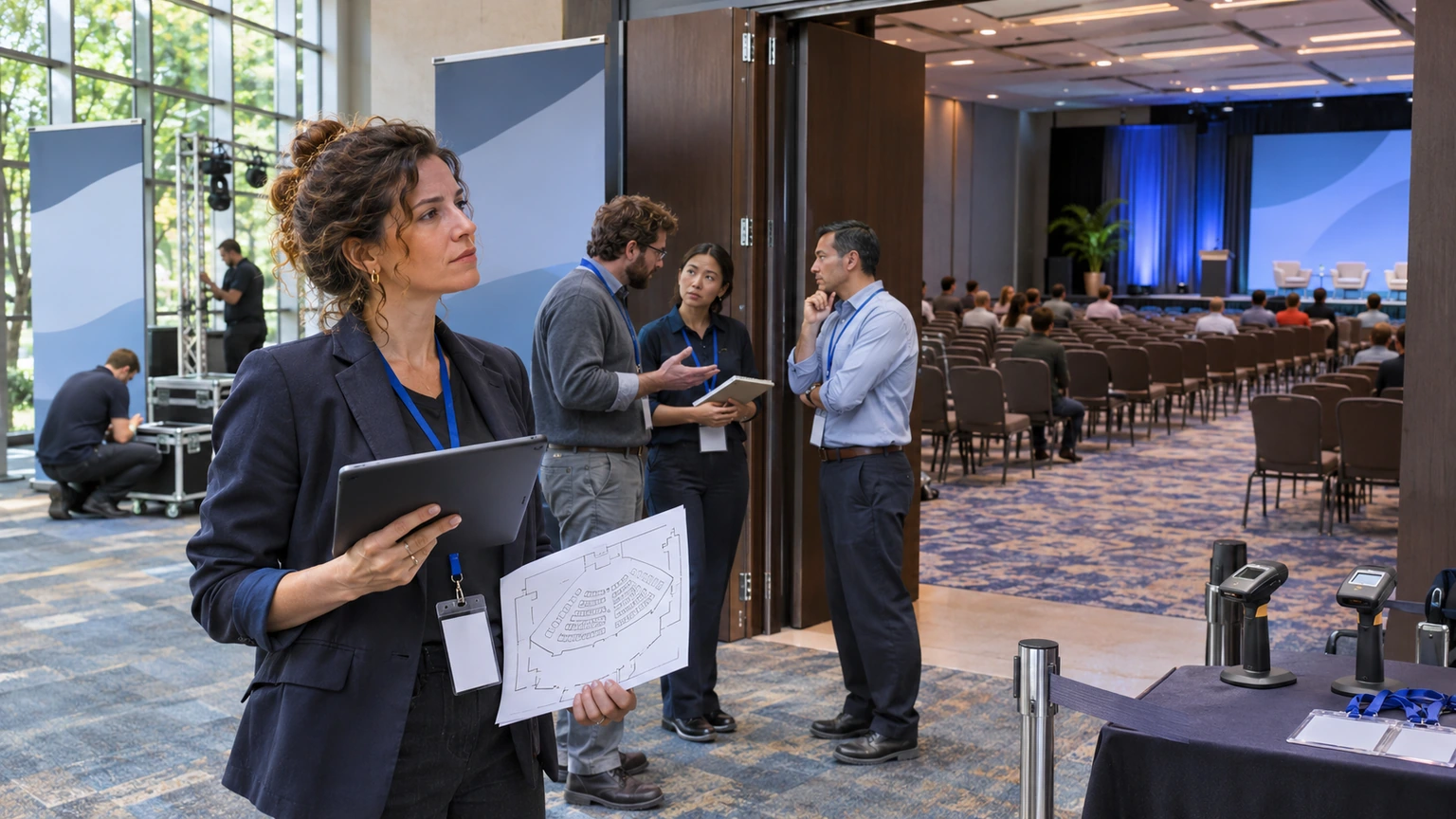
Attendance declines at a major industry conference tend to trigger fast conclusions.
Some people read them as proof that the market is weakening. Others treat them as a one-off issue tied to timing, pricing, travel, content, or exhibitor value.
The more useful view for organisers is simpler: a reported decline is an operating signal.
In this case, the source idea points to discussion around lower attendance for a major tech conference in 2026, with proposed adjustments for 2027. That matters because conferences rarely change format, footprint, pricing, or programming unless organisers believe something in the attendee equation has shifted.
What it does not tell us on its own is the full cause of the decline, whether the issue is temporary or structural, or which fix will work best next year.
Attendance decline is not only a marketing problem. It is often a planning, positioning, and experience design problem.
Why this matters for event operations
For conference teams, attendance is not just a headline metric.
It affects almost every operational decision before, during, and after the event:
- venue space planning
- staffing levels
- sponsor and exhibitor expectations
- agenda density and room allocation
- food and beverage forecasting
- check-in and crowd flow design
- budget confidence
- renewal conversations for the following year
When attendance softens, the risk is not only empty seats. The bigger risk is running an event that was designed for demand that never arrives.
That creates visible gaps. Large rooms feel flat. Sponsor areas feel quieter than promised. Networking energy drops. Teams can end up overspending to deliver an experience built for a different volume.
What we can say, and what we cannot
From the source signal, it is reasonable to say that reported attendance declines at a major tech conference deserve attention from organisers across the industry. It is also reasonable to say that planned adjustments for the following year suggest the organisers see a need to respond rather than stay on the same course.
What we cannot say from this source alone is:
- the precise cause of the decline
- whether pricing, travel cost, market timing, programme relevance, or competition played the biggest role
- that all tech conferences will face the same pattern
- that one year of weaker attendance automatically predicts long-term decline
- that any specific operational change will reverse the trend
That distinction matters. Good event teams should treat this as a market signal, not as proof that one explanation has already won.
The first mistake is to overreact to the headline. The second is to ignore it.
Start with the demand model, not the narrative
When attendance drops, teams often jump straight to stories: people do not travel anymore, the content was weaker, budgets were cut, digital replaced in-person, the industry has changed.
Some of those stories may be partly true. They are still not a demand model.
A better starting point is to review how attendance was expected to happen in the first place.
Ask practical questions:
- which audience segments were expected to grow
- which segments actually slowed down
- how much of demand depended on repeat attendees
- how much relied on employer-funded travel
- whether conversion weakened early or late in the registration cycle
- whether certain pass types underperformed more than others
- whether exhibitor attendance held up differently from general attendees
This matters because not all attendance declines mean the same thing. A drop in sponsored corporate attendees is different from a drop in indie developers, startup founders, buyers, students, or press.
Different demand problems need different fixes.
What attendance declines may actually signal
1. Higher scrutiny on travel value
Many tech events depend on people justifying time away, flight costs, accommodation, and ticket spend.
If attendance falls, one explanation may be that the event still matters, but not enough to clear a higher internal approval bar.
For organisers, that shifts the job from promotion to justification. The event page, agenda, and outreach need to make the value case more concrete.
2. The programme may not feel distinct enough
Tech audiences have many ways to access information without travelling.
If the conference promise sounds like content people can get elsewhere, attendance may weaken even when brand recognition stays strong.
That does not mean content is unimportant. It means content alone may not be enough. Community access, deal-making, hands-on demos, career value, and live peer interaction may need to carry more of the proposition.
3. Event scale may have drifted away from attendee energy
Some conferences keep the footprint of a peak year while the live demand pattern changes.
The result is not only lower attendance. It is a thinner experience.
Rooms look sparse. Expo aisles feel uneven. Serendipity drops. The event can feel less important than it actually is because the physical design exaggerates the gap.
4. Audience mix may be changing faster than the event format
Tech markets move quickly. Job roles change. buyer groups shift. Communities fragment and recombine.
If a conference still serves last cycle's audience structure, attendance can soften even when the broader sector remains active.
That is often when organisers need to rethink tracks, pass categories, hosted formats, side events, or who the event is really for.
How organisers should respond operationally
Reforecast early and honestly
Once weaker demand becomes visible, many teams hold onto the original target for too long.
That usually makes later decisions worse.
A practical response is to create three working scenarios:
- base case, if current pace continues
- recovery case, if later conversion improves
- constrained case, if softness persists
Then tie key operating choices to those scenarios. That includes space usage, temporary staffing, print volumes, food commitments, and sponsor servicing plans.
Scenario planning is less dramatic than a last-minute cut. It is also more controllable.
Review where scale is helping and where it is hurting
Bigger is not always better when turnout is under pressure.
Organisers should assess whether the current layout still supports energy and usability.
Useful review points include:
- can underused room blocks be consolidated
- can networking and expo activity be concentrated instead of spread thinly
- can session scheduling reduce visible empty periods
- can entrances, registration, and circulation be simplified for the actual volume
The goal is not to hide decline. It is to protect the live experience from feeling diluted.
Adjust stakeholder communication before frustration builds
Attendance softness becomes much harder to manage when sponsors, exhibitors, speakers, and internal teams all discover the gap through the live atmosphere.
That is when trust erodes.
Clear communication should start earlier. If the event is making format or planning adjustments for the following year, that should be framed around experience quality, audience fit, and delivery strength, not vague optimism.
Stakeholders usually respond better to realistic planning than to inflated confidence.
What to examine in your own conference data now
You do not need a crisis to learn from this pattern.
Every conference team should review a short set of indicators before the next planning cycle:
- registration pace by week versus previous editions
- conversion rate by audience type or pass category
- discount dependency
- no-show rate and late cancellation rate
- session fill patterns
- exhibitor staffing levels and badge allocation usage
- meeting or networking participation, if tracked
- renewal intent from sponsors and exhibitors
These signals help teams see whether the problem is top-of-funnel interest, pricing resistance, travel friction, weak agenda pull, or poor retention from past attendees.
Without that separation, teams often fix the wrong thing.
Questions to ask before making 2027-style adjustments
If an organiser is already considering structural changes for the following year, the review should stay concrete.
Useful questions include:
- are we trying to recover volume, improve fit, or protect experience quality
- which audience groups matter most to the event's long-term model
- does the current agenda reflect the people we most need to attract
- are ticket types and pricing still aligned with buying reality
- is the venue footprint still appropriate
- what sponsor outcomes are most at risk if attendance remains softer
- which changes can be tested without destabilising the whole event
Not every adjustment needs to be dramatic. Sometimes the biggest gain comes from tighter positioning, stronger audience segmentation, and better use of space.
Where teams should be careful
There are a few common overcorrections.
- Do not assume lower attendance means lower interest in the category overall.
- Do not cut community or networking elements first if those are part of the event's real differentiation.
- Do not keep the same footprint for symbolic reasons if it weakens the attendee experience.
- Do not promise sponsors the same outcome using the same language if audience behaviour has changed.
- Do not rely on one explanation without checking segment-level data.
The operational job is not to defend the past plan. It is to redesign around current reality.
What good looks like
A well-run conference does not need to break attendance records to feel successful.
It needs a believable value proposition, a right-sized experience, and stakeholder communication that matches the facts.
When organisers respond well to softer attendance, the event usually shows a few strengths:
- the space feels active rather than overstretched
- the agenda matches the audience that actually attends
- sponsors understand the quality of interactions they are buying
- staffing and service levels fit the real demand pattern
- next-year planning starts from evidence, not wishful thinking
What this means for event teams
Reported attendance declines at a major tech conference should not trigger panic. They should trigger better questions.
If the market is changing, organisers need to understand whether the pressure is coming from budget scrutiny, programme relevance, audience mix, event scale, or a combination of factors.
That is where practical planning matters most.
The teams that handle attendance softness best are usually not the ones with the strongest spin. They are the ones that reforecast early, protect attendee energy, communicate clearly, and make next-year changes with evidence behind them.
For conference organisers, trade show managers, and venue partners, that is the real lesson: attendance is not only a number to report. It is a signal that should shape the event you build next.