
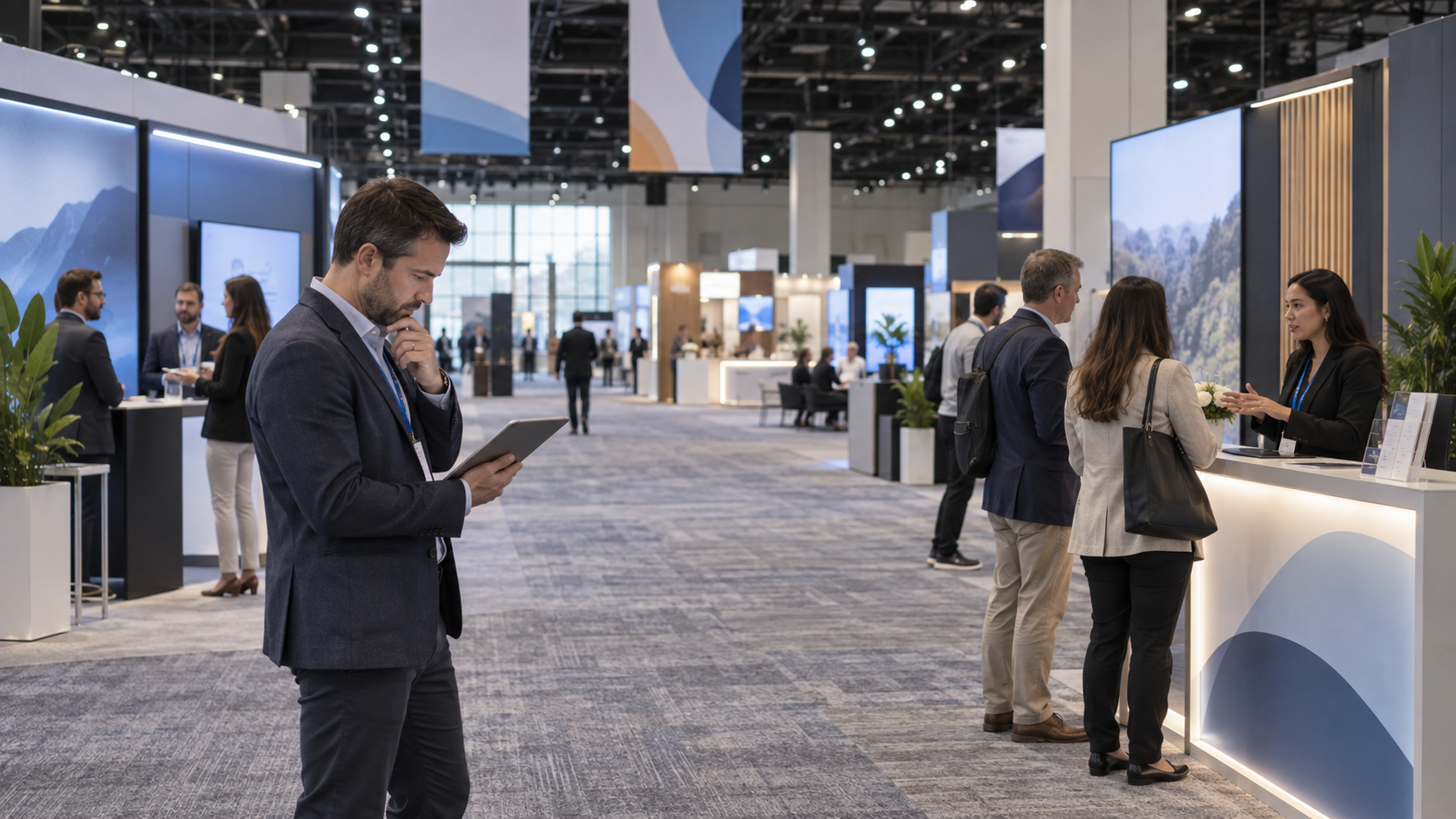
Reported attendance at the 2026 CEDIA Expo fell by more than 14%, and public coverage suggests the rate of decline is accelerating.
For expo organizers, exhibitors, and venue teams, that is not just a headline about one event. It is a useful operational warning.
When attendance softens, the pressure does not stay at the top-line number. It moves into exhibitor ROI, sponsor confidence, floor traffic patterns, meeting volume, and the perceived energy of the show itself.
Attendance decline matters partly because fewer people show up, but mostly because the event model built around that audience can start to wobble.
Public reporting alone cannot explain every cause. One expo may be affected by industry conditions, travel patterns, timing, format fatigue, or budget pressure. Still, the signal is worth taking seriously.
The practical question is not only how to win back physical attendance. It is how to protect event value when in-person turnout becomes less predictable.
Why this matters
Many expo teams are still structured around assumptions that were safer in stronger attendance years:
- exhibitors expect reliable booth traffic
- sponsors expect visible audience scale
- education sessions assume healthy room fill
- networking formats depend on dense participation
- venues and organizers plan staffing around historical patterns
When those assumptions weaken, the event can still run on schedule while delivering a less convincing outcome.
That is the danger. Decline often shows up first as a quality problem before it becomes a viability problem.
What a drop in attendance usually changes on the expo floor
Lower attendance rarely affects every part of the show evenly.
In practice, teams often see a mix of issues:
- slower booth traffic outside peak hours
- more uneven flow between premium and peripheral zones
- weaker session conversion from general floor traffic
- fewer spontaneous meetings
- greater pressure from exhibitors to prove outcomes more clearly
- more attention on whether the audience quality improved, not just whether quantity fell
This is why event teams should avoid responding only with broader marketing language about excitement or community. If the attendance base is shifting, the operating model has to shift too.
When footfall becomes less dependable, every meaningful interaction has to be easier to find, easier to book, and easier to measure.
Do not treat digital as a backup to the live event
A common mistake is to frame digital experiences as the consolation prize for people who did not attend.
That is too narrow.
For expos, digital layers work best when they do three jobs at once:
- they help more people participate, even if not all of them travel
- they make in-person time more productive for those on site
- they extend exhibitor and sponsor value beyond floor traffic alone
That does not mean replacing the physical show. It means reducing dependence on a single measure of success.
Where digital experiences can actually help
Not every digital feature improves an expo. The useful ones support real event behavior.
1. Pre-event planning
If attendance is softer, random discovery becomes less reliable as a value driver.
Teams should help attendees and exhibitors plan meaningful interactions in advance.
- promote meeting requests before the event opens
- highlight relevant exhibitors by category or audience interest
- surface education sessions early so people build clearer agendas
- give sponsors defined digital visibility before arrival, not only on site
This shifts value from chance traffic to intentional participation.
2. Digital exhibitor presence
Exhibitors feel attendance drops quickly because they experience them at booth level.
A stronger digital presence can reduce that exposure when it is tied to actual discovery and follow-up.
Useful elements may include:
- searchable exhibitor profiles
- product or solution listings
- scheduled demos or appointment windows
- clear contact and follow-up pathways
The goal is simple: if a buyer does not pass the stand physically, the exhibitor should still be findable.
3. Hybrid or remote content access
Some people who skip an expo are not uninterested. They are constrained.
Travel cost, time pressure, and internal approval delays can all block attendance even when interest remains strong.
Selective digital access to keynote or education content can help preserve audience reach and brand relevance. It can also create a pathway for future in-person conversion.
Teams should stay realistic here. Streaming alone does not solve attendance decline. But content access can protect value for speakers, sponsors, and the wider community.
4. Better meeting design
If fewer people are on site, the event must create more efficient ways for the right people to connect.
That can include:
- appointment-led networking
- buyer-seller matching workflows
- topic-based meeting zones
- digital scheduling around exhibitor teams
This is often more effective than hoping lower traffic will still produce enough serendipity.
5. Post-event continuation
When attendance is under pressure, the value window after the show matters more.
Post-event follow-up should not begin as an afterthought. It should be designed before the event starts.
- keep exhibitor profiles live for a defined period
- extend access to selected session content
- support follow-up conversations while interest is still fresh
- share audience and engagement reporting in a clear, usable form
This helps the expo behave less like a three-day spike and more like a measurable commercial cycle.
What organizers should review now
If public attendance declines are becoming more common in parts of the exhibition market, organizers should review their event model before the next sales cycle begins.
Look closely at these areas
- traffic dependence: how much exhibitor value still relies on walk-by volume alone
- meeting infrastructure: whether the event makes planned interactions easy enough
- content reach: whether educational value ends at the room door
- sponsor inventory: whether visibility options depend too heavily on physical impressions
- data capture: whether teams can show what attendees actually did, not just how many registered
These questions matter even if the event is still healthy. It is easier to adapt while the show remains commercially credible than after confidence starts to slip.
What exhibitors should do if floor traffic feels less certain
Exhibitors should also adjust their planning model.
If the market is producing less predictable attendance, booth design alone will not carry performance.
A more resilient approach includes:
- setting meeting targets before the event
- promoting stand activity digitally in advance
- giving visitors a simple reason to book time, not just drop by
- training staff for lead quality, not only lead quantity
- planning post-show follow-up as part of the activation, not a separate task
This does not remove the importance of physical presence. It makes that presence work harder.
Stay careful with public signals
One reported attendance decline should not be treated as a universal rule for every expo category.
Some sectors remain strong. Others may be restructuring around a smaller but more qualified audience. In some cases, total attendance may matter less than buyer concentration or exhibitor conversion.
That is why public news is best used as a signal to review assumptions, not as proof that every event needs the same response.
Still, when a well-known expo reportedly posts a drop of more than 14%, it becomes harder to dismiss the issue as noise.
What this means for event teams
Attendance pressure does not automatically mean the expo model is broken. But it does mean older definitions of value may be too fragile.
The strongest response is not panic, and it is not empty optimism. It is redesign.
Expos should be easier to plan, easier to navigate, easier to matchmake, and easier to continue digitally after the floor closes.
If in-person attendance becomes harder to grow consistently, the event that wins will usually be the one that turns every available audience touchpoint into something more deliberate and more measurable.
That is where digital experiences can help most, not by imitating the floor, but by making the whole expo work better around it.